Home charging
Home EV charging in New Zealand: how it works
How home EV charging works in NZ: charging speeds, the equipment you need, overnight charging and off-peak plans. The complete New Zealand guide.
In short
Most New Zealand EV owners do most of their charging at home, plugging in overnight from a wall-mounted charger installed by a Registered Electrician. A typical 7kW charger adds roughly 40km of range an hour, so an overnight charge easily covers a normal day's driving. Running cost comes down to the rate you charge at rather than the charger you buy — the running-cost calculator works out your own figure.
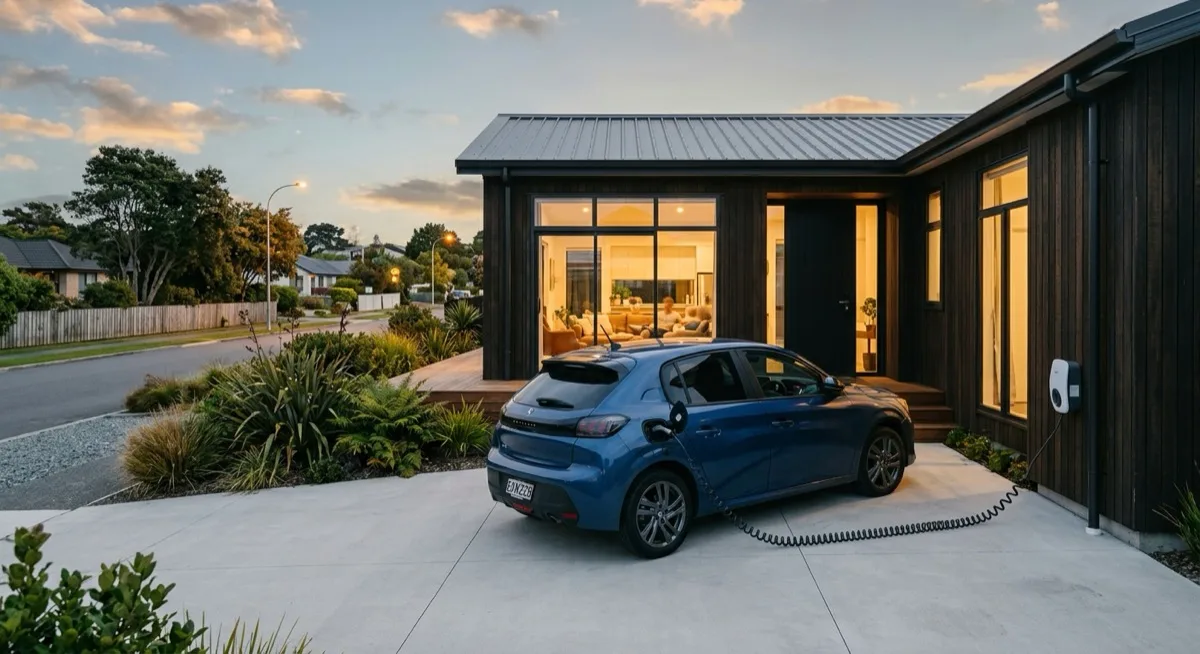
If you’ve just bought an EV, or you’re about to, home charging is the single biggest change to how you’ll “fuel” it. Instead of stopping at a station, you plug in where you park and top up overnight. This guide explains how home EV charging actually works in New Zealand, what it costs to run (not just install), and how to set yourself up for the cheapest, most convenient charging. Facts here are verified July 2026.
What “home charging” actually means
Charging an EV at home is AC charging. Your home’s alternating-current supply feeds the car, and the car’s onboard charger converts it to top up the battery. It’s slower than the DC fast chargers you see at public stations, but that’s by design: you’re not waiting at the car. You plug in when you get home and unplug in the morning, the same way you charge a phone overnight.
For most New Zealanders this covers the large majority of their driving. The typical EV has more than enough range for a normal day’s commute and errands, so an overnight top-up keeps the battery comfortably full and you rarely think about “filling up” at all. Public charging then becomes something you only use on longer road trips.
The three ways to charge at home
There are really three options, fastest to slowest:
- A dedicated 7kW wall charger (most common). A wall-mounted unit on its own circuit, installed by a Registered Electrician. It adds roughly 40km of range per hour, so it refills a normal day’s driving in a couple of hours and a near-empty battery overnight. This is what most NZ homes install.
- A portable EVSE on a standard socket (trickle charging). The cable that came with your car, plugged into a normal 3-pin wall socket. It’s much slower, around 10km of range per hour, and best treated as a backup or for plug-in hybrids with small batteries. Our portable vs wall-mounted guide covers when trickle charging is enough.
- 11kW or 22kW on three-phase power. Faster AC charging, but it needs a three-phase supply, which many NZ homes don’t have, and for overnight charging you rarely need it. Most owners are better served by a 7kW single-phase unit; see the 7kW vs 22kW guide.
Not sure which suits you? The EV charger chooser walks you through speed, smart features and brand based on your car and parking.
How fast does home charging actually go?
The number that matters day-to-day is range added per hour, not the headline kW. As a rule of thumb a 7kW charger adds about 40km of range per hour. So:
- An hour while you make dinner ≈ enough for tomorrow’s commute.
- A full overnight charge (say 6–10 hours depending on battery size) takes most cars from low to full.
That’s the key insight that surprises new owners: you almost never charge from empty to full in one sitting. You top up from wherever you happened to be, overnight, on cheap power. The battery spends most of its life comfortably part-charged rather than run flat.
What it costs to run
This is where home charging earns its keep. Once a charger is installed, the only ongoing cost is electricity, and the lever that matters most is the rate you charge at, not the charger you bought.
- Charge overnight on an off-peak or EV plan. Several NZ retailers offer plans with cheap overnight windows or specific EV rates. From 1 July 2026, large electricity retailers are required to offer a time-of-use plan to most customers (Electricity Authority), which makes shifting your charging into the cheapest hours easier than ever. Our guide to EV power plans compares the named plans and off-peak windows.
- Model your own numbers. What you actually spend depends on your car’s efficiency, your annual mileage and your electricity rate, so a single “it costs $X” figure is misleading. See what it costs to charge an EV at home with the calculator, which compares home charging against petrol for your car and driving.
- A smart charger does the work for you. Pair an off-peak plan with a smart charger and it starts charging automatically in the cheap window: you plug in at any time and it waits for the right hours. If you have solar, a solar-diverting charger can charge from your surplus generation instead of exporting it cheaply.
Two honest caveats. First, NZ EV policy has moved away from incentives: Road User Charges have applied to light EVs since 1 April 2024 (NZTA), so factor RUC into your running cost. It doesn’t erase the saving over petrol, but it’s real. Second, there is no government subsidy for a home charger in NZ; if you’ve seen one quoted, it’s almost certainly an overseas scheme (see our home-charger subsidy guide).
Charging habits and battery health
You don’t need to baby an EV battery, but a couple of habits help it last:
- Top up little and often rather than running to empty and charging to 100% every time. Most owners plug in nightly regardless of how full the battery is.
- For daily use, many set a charge limit around 80%, leaving full charges for the day before a long trip. Most smart chargers and the car itself let you set this once and forget it.
These are habits, not rules (modern EVs manage their own battery health well), but they cost nothing and they suit the overnight top-up pattern home charging encourages anyway.
Home vs public charging
It’s worth being clear on how the two fit together:
- Home charging is cheap, slow and convenient, ideal for everyday driving while the car is parked anyway. It’s where most owners do most of their charging.
- Public DC fast charging is quick but priced for convenience; it’s for topping up on longer trips, not your daily refill.
The gap shows up clearly in the per-kWh cost. These are indicative NZ rates (they vary by retailer, region and network; verified July 2026); use them to compare, not as a quote:
| Where you charge | Indicative cost | Best for |
|---|---|---|
| Home, off-peak / EV plan | ~18–22c per kWh | Everyday overnight charging (the cheapest option) |
| Home, standard anytime rate | ~35–42c per kWh | Daytime top-ups if you’re not on an off-peak plan |
| Public DC fast charger | ~60–85c per kWh (sometimes plus a time fee) | Speed on longer trips, not daily use |
So charging a typical EV at home overnight can cost roughly a quarter to a third of what the same energy costs at a public fast charger. To see it in dollars for your own car and mileage, use the running-cost calculator; to find the cheapest home rate, compare EV power plans.
The practical result is that a home setup changes the economics of EV ownership more than any single trip ever does. If you have off-street parking, home charging is the default. If you don’t, it’s still possible but needs more thought (see charging an EV without off-street parking).
Getting set up at home
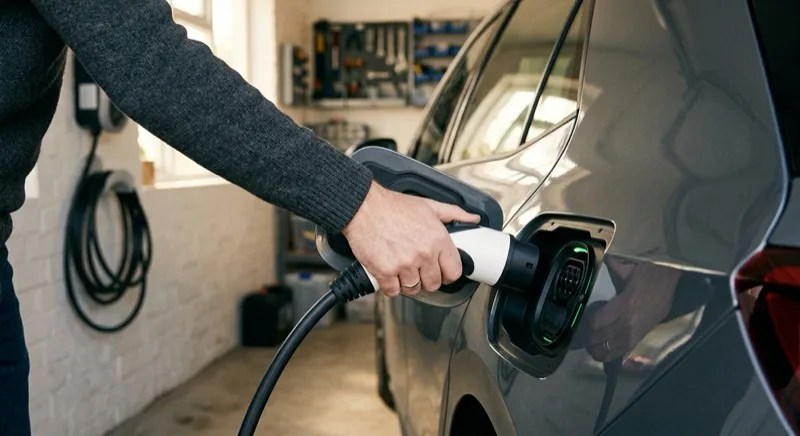
A portable cable works out of the box on a normal socket, but for daily use most people install a fixed 7kW wall charger. That’s electrical work: in New Zealand it must be done by a Registered Electrician, who runs a dedicated, protected circuit and issues a Certificate of Compliance for the finished installation. It is not a DIY or handyperson job (why this matters).
A typical 7kW wall-mounted install runs around $1,500–$2,500, depending mainly on the cable run, your switchboard, and whether you’re on single- or three-phase supply. For the full picture of what’s involved and what drives the price, see the EV charger installation guide and the detailed cost breakdown.
The bottom line
Home charging is the quiet superpower of EV ownership in NZ: plug in where you park, charge overnight on cheap power, and skip the petrol station for everyday driving. Get the basics right (a 7kW charger if you can, an off-peak power plan, and the overnight top-up habit) and running an EV becomes both cheaper and more convenient than the car it replaced. When you’re ready to install, get free quotes from local Registered Electricians and compare them on price and scope.
Frequently asked questions
Can I charge my EV at home in New Zealand?
Yes. Home charging is how most New Zealand EV owners do most of their charging. You plug in overnight from a wall-mounted charger (or, more slowly, a portable unit on a standard socket) and wake up with a full battery. A fixed wall charger must be installed by a Registered Electrician, but once it is in, day-to-day charging is as simple as plugging in your phone.
How much does it cost to charge an EV at home in NZ?
It depends on your power rate and how far you drive, but charging overnight on an off-peak or EV power plan is the cheapest way to run an EV in New Zealand, typically far less per kilometre than petrol. The exact figure comes from your car's efficiency, your annual mileage and your electricity rate. Use the running-cost calculator to model your own numbers.
How long does it take to charge an EV at home?
A typical 7kW home charger adds roughly 40km of range per hour, so an overnight charge easily refills a normal day's driving. A full charge from low to full might take 6–10 hours depending on battery size, which is fine when the car is parked overnight anyway. A standard 3-pin wall socket is much slower (around 10km of range per hour) and suits plug-in hybrids or light use.
Do I need a special charger to charge an EV at home?
Not strictly. Most EVs come with a portable cable that plugs into a normal socket for slow charging. But for daily use most owners install a dedicated 7kW wall charger, which is several times faster, safer for sustained high loads, and can be set to charge automatically in cheap off-peak hours. A fixed charger must be installed by a Registered Electrician.
Is it cheaper to charge at home or at a public charger?
Home charging is almost always cheaper than public DC fast charging. Public fast chargers are priced for convenience and speed; charging overnight at home on an off-peak rate costs a fraction as much per kWh. Most owners use home charging for everyday driving and public charging only on longer trips.
How much does it cost to charge an electric car at a public charging station in NZ?
Public DC fast charging in New Zealand is indicatively around 60–85c per kWh, sometimes with an added time-based fee, so a top-up is priced for speed and convenience. That's roughly three to four times the cost of charging at home overnight on an off-peak or EV plan (around 18–22c per kWh). Rates vary by network and region. Public charging makes sense for longer trips, while home charging is far cheaper for everyday driving.