Charger guide
Portable EVSE vs wall-mounted EV charger: which is right for your NZ home?
The real difference between a portable EVSE and a hard-wired wall-mounted charger: speed, safety, cost, and when each option makes sense for NZ homes.
If you’ve just picked up an EV, you’ll likely have received a portable EVSE in the boot alongside the car. It’s tempting to plug it in and call it done. Here’s an honest look at what you’re getting, and why most NZ homeowners with off-street parking end up going further.
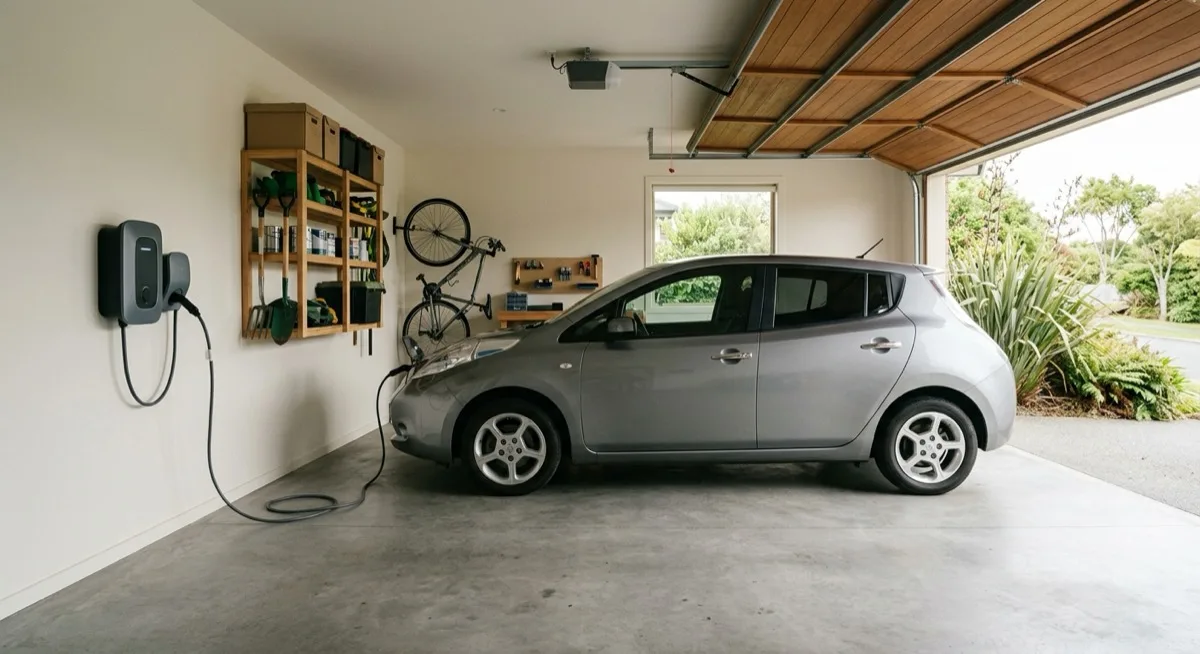
The short answer
- Portable EVSE (trickle charger): plugs into a standard socket; slow (~2–2.3kW, ~10–14km range/hr); low upfront cost; fine for occasional top-ups or travel.
- Wall-mounted charger: hard-wired to a dedicated circuit by a Registered Electrician; fast (~7kW, ~40km range/hr); the right answer for daily charging at home.
For most NZ households with off-street parking, a wall-mounted unit is the practical long-term choice. The portable unit earns its keep as a backup for trips away, not as a daily driver.
What is a portable EVSE?
EVSE stands for Electric Vehicle Supply Equipment, the correct term for what most people call a “charger” (technically the charger is inside the car). A portable EVSE is a box with a cable that plugs into a standard wall socket on one end and connects to your car’s Type 2 connector on the other.
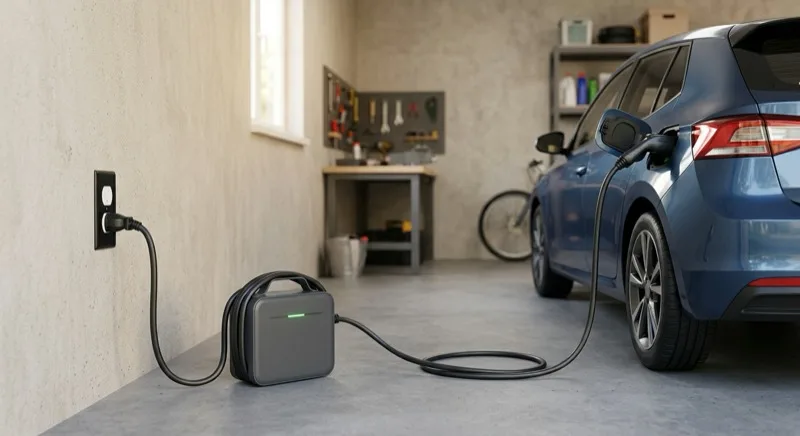
Most EVs sold in NZ include a portable EVSE in the box. These units typically support:
- A standard 10A / 3-pin domestic socket, delivering roughly 2–2.3kW
- Some models include an adapter for a 16A socket (sometimes called a “commando socket”), delivering roughly 3.6kW
No electrical work is required to use a portable EVSE. You plug it in, connect the car, and charging begins. That convenience is the appeal.
What is a wall-mounted charger?
A wall-mounted charger (often called a wallbox or home charging station) is a unit fixed to a wall, typically in a garage, carport, or on an exterior wall near your parking spot. It connects to the car via a tethered cable or a Type 2 socket.
Unlike a portable EVSE, a wallbox is wired permanently to a dedicated circuit running from your switchboard. That circuit carries only the EV charger load, is protected by its own RCD/RCBO, and is sized for continuous high-current use. The work must be done by a Registered Electrician and signed off with a Certificate of Compliance before the unit goes into service.
The standard for most NZ homes is a 7kW single-phase wallbox, which works on the same single-phase supply the majority of NZ homes have. See the 7kW vs 22kW guide if you’re weighing up higher-power options.
Speed: the practical difference
This is where the two options diverge most sharply.
| Option | Power | Range added per hour (approx.) |
|---|---|---|
| Portable EVSE (10A / 3-pin socket) | ~2–2.3kW | ~10–14 km/hr |
| Portable EVSE (16A socket) | ~3.6kW | ~20 km/hr |
| 7kW wall-mounted charger | 7kW | ~40 km/hr |
New Zealand’s average daily driving distance is well under 50km. At 2.3kW, you’d need to charge for roughly four to five hours to recover that daily distance. A 7kW wallbox gets you there in about ninety minutes, and a full overnight charge from low is comfortable rather than borderline.
For a car with a 60–80kWh battery, a full charge from near-empty via trickle charging can take 25 hours or more. Via a 7kW wallbox, the same battery is full in eight to twelve hours, overnight, with room to spare.
Safety: why dedicated circuits matter
This is the part worth understanding properly, without exaggeration.
A standard NZ domestic 3-pin / 10A socket is designed for appliances that cycle on and off: a kettle, a lamp, a phone charger. An EV charging session is different. It draws current at or near the socket’s rated limit, continuously, for several hours.
AS/NZS 3000 (the wiring rules used in New Zealand) sets requirements for circuits and connections based on sustained load, not just peak rating. Ordinary socket wiring and the socket itself may not be in ideal condition for the kind of sustained draw that EV charging places on it, particularly in older homes where sockets may have seen years of use. Heat build-up in a loose or aging connection under continuous load is the mechanism that creates risk.
A dedicated circuit installed by a Registered Electrician uses cable and connections sized and rated for sustained EV loads, with an RCD/RCBO sized accordingly. The risk that a standard socket presents under continuous heavy use is designed out from the start.
The practical guidance from bodies including WorkSafe NZ and EECA is consistent: for regular home charging, a dedicated circuit is the appropriate solution. A portable EVSE on a standard socket is acceptable for occasional use; it is not intended as a permanent daily charging arrangement.
Cost: what you’re actually comparing
The two options have very different cost structures:
Portable EVSE
The hardware is often included with the car. If purchased separately, portable EVSEs range from lower-cost basic models to more capable units with 16A adapters, but there is no installation cost because no electrical work is required.
Wall-mounted charger
Hardware plus installation. A typical 7kW wall-mounted install runs indicatively around $1,500–$2,500 all-in. That covers charger hardware and a Registered Electrician running a dedicated circuit, making connections at the switchboard, and issuing a Certificate of Compliance. The actual figure depends on switchboard capacity, cable run distance, parking location, and whether any switchboard work is needed. See the full EV charger installation cost guide for a detailed breakdown of every variable.
There is no licensed shortcut: installing a dedicated circuit is electrical work under NZ law, and it must be done by a Registered Electrician registered with the EWRB (Electrical Workers Registration Board).
When a portable EVSE is genuinely fine
Despite the limitations, there are real situations where a portable unit is the right tool:
- Travel and away-from-home charging. A portable EVSE in the boot lets you top up at a friend’s house, a holiday let, or anywhere with a standard socket, without needing a wallbox at the destination.
- Apartments and rentals. If you don’t have off-street parking you control, or your lease situation makes electrical work impractical, a portable EVSE may be your only option for home charging. Worth discussing with your landlord and checking what your body corporate allows.
- Very low daily mileage. If you drive 20–30km a day and consistently have 8–10 hours parked at home overnight, a 16A portable setup can work mathematically, though the dedicated circuit question still applies.
- Interim use. While you’re waiting for your wallbox installation appointment, a portable EVSE lets you keep driving. Most installers expect a few weeks’ lead time for scheduling.
If you fall into the first category (travel backup), a portable EVSE is the right answer. For the others, it’s a workaround rather than a solution.
Our recommendation
If you have off-street parking and own your home: install a wall-mounted charger.
A dedicated 7kW circuit costs more upfront than doing nothing, but it removes the sustained-socket concern entirely, charges three to four times faster, and gives you a setup that’s genuinely designed for the job. The Certificate of Compliance also matters for insurance purposes and future property sale.
The portable EVSE that came with your car is worth keeping as a travel backup. It’s useful precisely because you don’t have a wallbox at every destination. But for nightly charging at home, it’s a workaround, not the right tool.
Not sure if your switchboard can support a dedicated circuit, or whether you’d need any upgrade work? A Registered Electrician can assess this in person. For more on what electricians can and can’t certify for EV work, see can any electrician install an EV charger?
What to send for an accurate quote
The more detail you include upfront, the less chance of surprises once work starts. Useful things to include when you request a quote:
- A photo of your switchboard (door open if safe): lets the installer assess available capacity and flag any likely upgrade early.
- A photo of your parking location: garage, carport, or driveway; covered or exposed; distance from the house.
- Approximate cable route from switchboard to charger location: distance and any obstacles such as solid walls, paving, or a long external run.
- Your EV make and model: confirms the Type 2 socket standard and your car’s maximum AC charge rate.
- Whether you have single-phase or three-phase supply: if you’re unsure, the electrician will confirm on-site, but knowing in advance speeds things along.
- Any smart-charging preferences: scheduled overnight charging, solar integration, or load management if relevant.
Frequently asked questions
Is a portable EV charger safe to use at home in NZ?
A portable EVSE used occasionally on a sound, dedicated 16A socket is generally safe for infrequent top-ups. The concern is regular long sessions on a standard domestic 3-pin socket, because ordinary household socket wiring is not designed for sustained high-current draws. A hard-wired dedicated circuit removes that risk entirely.
How fast does a portable EV charger charge compared to a wall-mounted unit?
A portable EVSE on a standard 10A socket delivers roughly 2–2.3kW, adding about 10–14km of range per hour. A wall-mounted 7kW charger on a dedicated circuit adds about 40km of range per hour, roughly three to four times faster.
Can I use a portable EV charger as my main home charger in NZ?
You can, but most NZ homeowners with off-street parking end up installing a wall-mounted unit. Trickle-charging at 2–2.3kW adds only 10–14km of range per hour, and sustained use of a standard socket for EV charging is not what domestic wiring is designed for.
Do I need a Registered Electrician to install a wall-mounted EV charger?
Yes. In New Zealand, installing a dedicated charging circuit is electrical work that must be carried out by a Registered Electrician and signed off with a Certificate of Compliance. Using an unqualified person is illegal and will affect your insurance.
What does a wall-mounted EV charger installation cost in NZ?
A typical 7kW wall-mounted install runs indicatively around $1,500–$2,500 all-in. That covers the charger hardware plus a Registered Electrician running a dedicated circuit and issuing a Certificate of Compliance. The exact figure depends on switchboard capacity, cable distance, and your parking situation.
Will a wall-mounted charger work with any EV sold in NZ?
Almost all modern EVs and PHEVs sold in NZ use a Type 2 connector, which is the standard socket on wall-mounted chargers. A Registered Electrician can confirm compatibility for your specific vehicle before hardware is ordered.