Costs & subsidies
Is there a government subsidy or rebate for a home EV charger in New Zealand?
No: New Zealand has no government subsidy or rebate for installing a home EV charger. Here's the accurate NZ position, and how to cut your charging cost instead.
If you’ve searched for an EV home charger subsidy in New Zealand, you’ve probably found a lot of confusing results, many of them quoting rebates that turn out to be British or Australian. This page gives you the accurate NZ position, and what to do instead to bring your charging cost down. Facts here are verified July 2026.
The short answer
There is no government subsidy or rebate for installing a home EV charger in New Zealand. There never has been one. No national grant, no per-install rebate, no tax credit for putting a charger on the wall of a private home.
That is genuinely the answer most searchers are looking for, and most of the content ranking for this query gets it wrong by mixing in overseas schemes. So before you budget around a subsidy that doesn’t exist: there isn’t one. The constructive part, how to actually reduce what home charging costs you, is further down this page.
Why people think a subsidy exists
Two things create the confusion.
First, the Clean Car Discount. This was a real government rebate, but it applied to the purchase of a low-emission vehicle (not to charging equipment) and it ended on 31 December 2023 (NZTA). Even while it ran, it never covered home charger installation. People remember “there was an EV rebate” and assume it extended to chargers. It didn’t, and it’s gone.
Second, overseas schemes. The UK has run an EV chargepoint grant for certain households, and several Australian states have at times offered charger or EV rebates. These are frequently quoted in generic, internationally-written EV content that isn’t specific to New Zealand. None of them apply in NZ. If a page promising a “home charger grant” doesn’t cite a New Zealand government source, treat it as not applicable here.
What about EECA funding?
The Energy Efficiency and Conservation Authority (EECA) does co-fund EV charging infrastructure in New Zealand, but that funding is directed at public charging and fleet/workplace charging, not chargers installed at private homes (EECA). Public co-funding has historically supported the nationwide fast-charging network and helped businesses electrify their vehicle fleets.
A homeowner installing a 7kW wall charger in their garage is not eligible for this kind of support. So while it’s true that “the government funds EV charging,” that support has never reached the private home charger, and you shouldn’t count on it when planning your install.
NZ EV policy has moved away from incentives
It’s worth being clear-eyed about the direction of travel, because it explains why a home-charger subsidy is unlikely to appear. Alongside the purchase rebate ending, Road User Charges (RUC) now apply to EVs: light electric vehicles came into the RUC system from 1 April 2024 (NZTA).
In other words, recent NZ policy has shifted toward charging EV owners for road use, not toward subsidising their equipment. That’s not a reason to avoid an EV (running costs per kilometre are still typically well below petrol), but it does mean you should plan your home charging around real prices, not a hoped-for rebate.
What actually cuts your home-charging cost
Here’s the useful part. The biggest lever on what home charging costs you isn’t a one-off subsidy: it’s the electricity rate you charge at.
- Switch to an off-peak or dedicated EV power plan. Several NZ retailers offer plans with very cheap overnight windows, or specific EV rates, designed for exactly this. Charging overnight on an off-peak rate can cost a fraction of the day rate. Over a year, that recurring saving dwarfs what a single rebate would have given you. See our guide to the best EV power plans in NZ.
- Model it before you switch. Our running-cost calculator lets you compare what different plans and charging habits would actually cost for your car and mileage, so you can pick the plan that pays off.
- Check retailer and lines company promotions directly. Some power retailers, and occasionally lines companies, run their own EV or charger promotions: bill credits, discounted hardware, or sign-up offers. These are commercial marketing offers, not government subsidies, they come and go, and the terms vary. If you want to know what’s on, ask your power retailer directly rather than relying on a third-party article.
There’s no rebate, but there is low-interest financing
A subsidy reduces the price; a loan just spreads it. There’s no subsidy, but there is low-cost lending, and it’s the accurate answer to “how do I pay for this.” Most major New Zealand banks now offer a low- or zero-interest “green” home-loan top-up, and several name a home EV charger as an eligible upgrade. These are commercial bank loans, not government money. Each is a top-up on an existing mortgage with that bank, subject to the usual lending and equity criteria, and you repay it in full. As at July 2026, the options that list EV chargers as eligible:
- ANZ Good Energy Home Loan top-up: up to $80,000 at a special fixed rate for three years (minimum $3,000 per top-up). ANZ names portable, single-phase, and three-phase wall-mounted chargers as eligible (ANZ).
- ASB Better Homes Top Up: up to $80,000 at 1% p.a. fixed for three years (minimum 20% equity). Portable or wall-mounted chargers qualify (ASB).
- BNZ Better Future home-loan top-up: up to $80,000 at 1% p.a. fixed for three years, covering EVs, plug-in hybrids, and chargers (BNZ).
- Westpac Greater Choices Home Loan: up to $50,000 interest-free for five years, for Westpac home-loan customers (minimum $150,000 lending, 20% equity). EVs and chargers are eligible (Westpac).
Amounts, rates, and criteria are set by each bank and do change, so confirm the current terms with your bank before you rely on them. The key point holds: this is money you borrow and pay back, not a grant that lowers the price. For most people the bigger, lasting saving is still the power plan you charge on, not how you finance the hardware.
What the install itself costs
There’s no subsidy to offset it, so it’s worth knowing the realistic number. A typical 7kW wall-mounted home charger install in New Zealand generally runs around $1,500–$2,500. That’s a range, not a fixed price, because the cost depends on real factors at your property:
- The cable run from your switchboard to the parking spot
- Whether your switchboard has spare capacity or needs work
- Whether you’re on single-phase or three-phase supply
- The charger model you choose
- Whether you have easy off-street parking for the unit
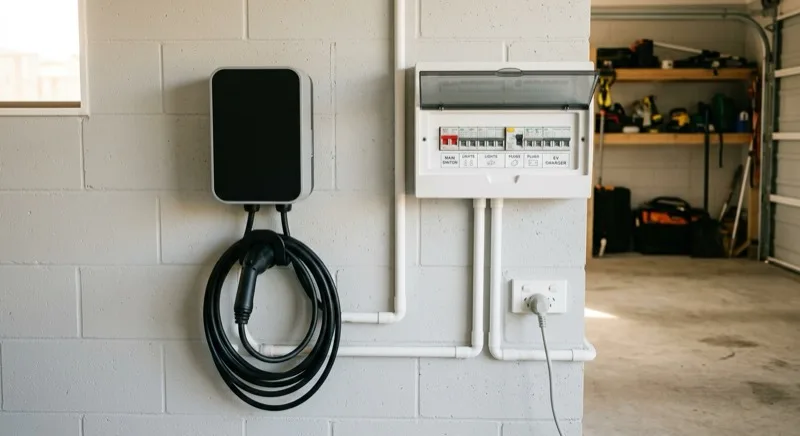
The work must be done by a Registered Electrician, who issues a Certificate of Compliance for the completed installation. For a full breakdown of what drives the price up or down, see our guide to EV charger installation cost in NZ, and the national overview at EV charger installation in NZ.
The bottom line
Don’t wait for a subsidy that isn’t coming, and don’t let an internationally-written article talk you into one. There is no NZ government rebate for a home EV charger as at July 2026. The money you’d hoped to save with a rebate is better found in the power plan you charge on. That’s a saving you keep every month.
When you’re ready to install, request free quotes from local Registered Electricians and compare them on price, scope, and what’s included, with no subsidy paperwork required.
Frequently asked questions
Is there a government subsidy for home EV chargers in NZ?
No. New Zealand has never had a national rebate or subsidy for installing a private home EV charger. Government funding through EECA has gone to public and fleet/workplace charging infrastructure, not chargers installed at private homes. Be cautious of online content that quotes UK or Australian rebates: those schemes do not apply in NZ.
Did the Clean Car Discount cover home chargers?
No. The Clean Car Discount was a rebate on the purchase of a low-emission vehicle, not on charging equipment, and it ended on 31 December 2023. It never covered home charger installation.
Are there any EV charger rebates in NZ in 2026?
There is no government home-charger rebate as at July 2026. The closest things are commercial, not government: most major banks (ANZ, ASB, BNZ, Westpac) offer a low- or zero-interest 'green' home-loan top-up that lists an EV charger as an eligible upgrade, and power retailers or charger brands sometimes run their own promotions. Those are loans and marketing offers, not subsidies, so check the terms directly with the provider.
How can I reduce the cost of charging at home instead?
Switch to an off-peak or dedicated EV power plan so most of your charging happens at the cheapest overnight rate. That makes a far bigger difference to your running costs than any one-off rebate would. Use the running-cost calculator to compare plans before you switch.
Do EV charger subsidies exist overseas?
Yes: the UK has run an EV chargepoint grant for certain households, and some Australian states have offered charger or EV rebates. None of these apply in New Zealand. NZ policy has in fact moved the other way, with the EV purchase rebate ending and Road User Charges now applying to EVs.