Safety guide
EV charger Certificate of Compliance: what it is and why you need it
What a Certificate of Compliance is for an EV charger install in NZ, why the law requires one, what it must contain, and what if you never got yours.
If you’ve just had a home EV charger installed, or you’re about to, one piece of paperwork matters more than any product warranty or app: the Certificate of Compliance. Here’s what it is, why the law requires it, and what to do if you don’t have one.
The short answer
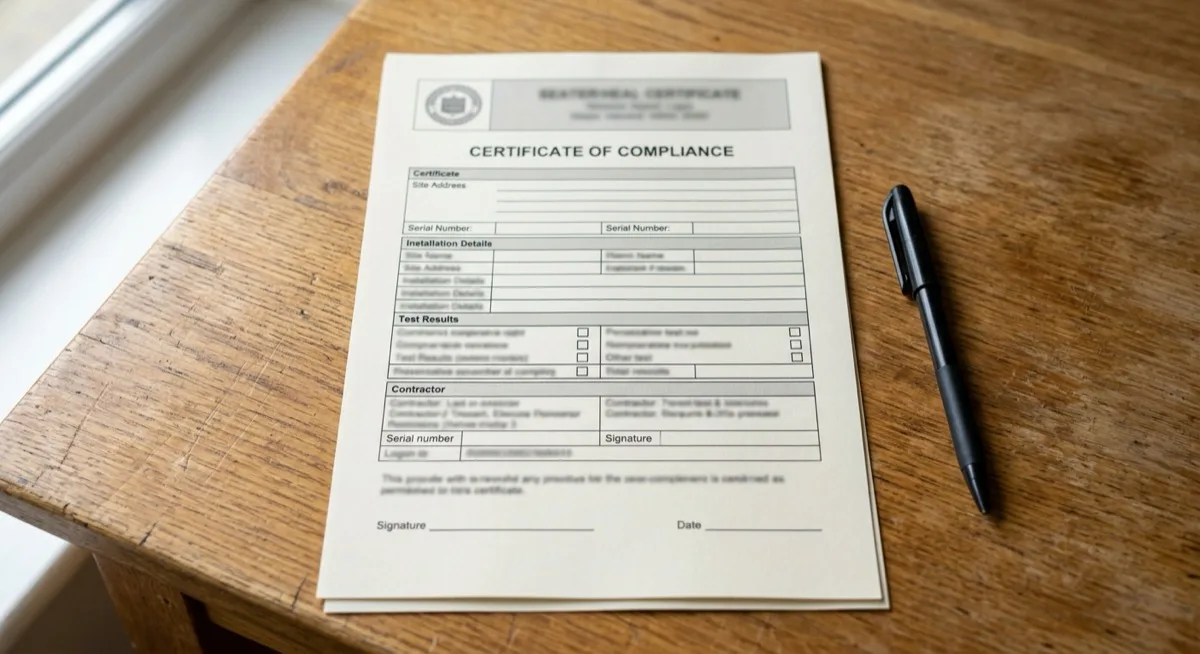
Every home EV charger installation in New Zealand requires a Certificate of Compliance (CoC) because the work is classified as prescribed electrical work under the Electricity (Safety) Regulations 2010. The CoC is issued by the Registered Electrician who carried out the installation. It is not optional, it is not an add-on, and you should refuse to consider the job finished until you hold it in your hands (or your inbox).
What a Certificate of Compliance actually is
A Certificate of Compliance is a formal document issued by the Registered Electrician who performed the prescribed electrical work. It certifies that:
- the work was carried out by a person legally permitted to do so,
- the work meets the applicable electrical safety standards, and
- the installation is safe and compliant as completed.
In New Zealand, electrical safety and worker registration are split between two bodies: the EWRB (Electrical Workers Registration Board) licenses electrical workers and runs the complaints and discipline process (Electrical Workers Registration Board, verified June 2026), while WorkSafe (Energy Safety) is the electrical safety regulator that administers the Electricity (Safety) Regulations 2010 (WorkSafe Energy Safety, verified June 2026). Those regulations set out the categories of prescribed electrical work and the compliance obligations that flow from them.
Think of the CoC as the paper trail that connects your specific installation back to a named, registered professional who certified it safe.
Why an EV charger installation legally needs one
Not all electrical work in a home is prescribed. Changing a lightbulb or swapping a socket cover is not. But installing a permanent home EV charger, which involves running a new dedicated circuit from your switchboard, fitting appropriate protection (RCD/RCBO), and connecting a fixed appliance drawing a sustained high load, is firmly in the category of prescribed electrical work.
Under the Electricity (Safety) Regulations 2010, no general prescribed electrical work may be treated as complete until a Certificate of Compliance is issued for it (Electricity (Safety) Regulations 2010, reg 65, verified June 2026). In practice that means the work:
- must be performed by a licensed electrical worker (not a handyman, not the person who sold you the charger, not an unlicensed worker). A person must be both registered and hold a current practising licence to do the work (EWRB Practising Licence, verified June 2026),
- must result in a Certificate of Compliance being issued to the property owner, and
- cannot be legally signed off by anyone who is not registered and licensed to do so.
This applies regardless of the charger brand, the charger speed, or whether the job looked simple. There is no carve-out for “small” EV charger installs. See can any electrician install an EV charger? for more on what the registration requirement means in practice.
Certificate of Compliance vs Electrical Safety Certificate
These two documents are related but distinct, and it’s worth understanding both:
A Certificate of Compliance (CoC) is issued by the electrician to certify that the prescribed electrical work itself was carried out correctly and complies with the regulations (reg 65). An Electrical Safety Certificate (ESC) certifies that the installation is safe to connect to the supply (reg 74A). The electrician issues one when satisfied the installation is electrically safe and compliant (Electricity (Safety) Regulations 2010, regs 65 & 74A, verified June 2026). The two are complementary, not alternatives, and both can apply to the same job.
One point worth knowing: where the work is classified as high-risk prescribed electrical work, the regulations require an additional Record of Inspection on top of the CoC. The ESC is not the “high-risk” extra, despite how it’s sometimes described online. For a straightforward home EV charger install your installer should provide the relevant certificate(s); if you are unsure what you’ve received, ask the electrician to confirm exactly what was issued and what it covers.
What the certificate should contain
A proper Certificate of Compliance for an EV charger installation should identify:
- the property address where the work was done,
- the date the work was completed,
- a description of the work (the new dedicated circuit, protection fitted, charger connected),
- the name and registration number of the Registered Electrician who carried out and certified the work,
- the electrician’s signature (or equivalent authorisation),
- reference to the Electricity (Safety) Regulations or applicable standard.
If the document you received does not identify the electrician by name and registration number, or does not describe the work clearly, contact them and ask for a complete version. A certificate that cannot be traced back to a registered individual has limited value.
Why you must keep this document
The CoC is not a piece of filing you can safely ignore. It has real, ongoing value in at least three situations:

Insurance. If a fault related to the EV charger installation ever results in a claim (a fire, electrical damage, property loss), your insurer will want to confirm the work was done by a Registered Electrician to the required standard. The CoC is that confirmation. Without it, a claim could be disputed or declined. It’s worth notifying your insurer when the charger is installed and letting them know you hold the CoC. For more on what safe home charging looks like end-to-end, see safe EV charging at home.
Property sale. When you sell your home, electrical upgrades (including a permanently installed EV charger) may be queried by a buyer’s solicitor, a building inspector, or through the LIM report. Being able to produce a CoC confirms the work was compliant; not having one creates uncertainty that can delay or complicate a settlement.
Fault investigation. If the charger or circuit develops a problem later, the CoC establishes what was certified at the point of completion. If the fault traces back to the original installation, the CoC is evidence of who signed off the work, useful if you need to pursue a remedy.
Keep your CoC with your other property compliance documents (ideally a physical copy and a scanned digital backup) for the full life of the installation.
What to do if you didn’t get one
This is more common than it should be. If you had a charger installed and never received a Certificate of Compliance, here is what to do:
Step 1: Contact the electrician in writing. Email or message them requesting the CoC explicitly. Keep the record of the request. A legitimate Registered Electrician should be able to produce the relevant documentation promptly.
Step 2: If they don’t respond or can’t provide it, check their registration status on the EWRB’s public register. If their registration has lapsed (or if they were never registered), that is a serious issue.
Step 3: Contact the EWRB. The EWRB (Electrical Workers Registration Board) is the body that licenses electrical workers and runs the complaints and discipline process, so it can investigate non-compliance with certification obligations (Electrical Workers Registration Board, verified June 2026). You can find their complaints process on the EWRB website.
Step 4: Get an independent inspection. Engage a different Registered Electrician to inspect the installation. They can assess whether the work was done safely and to standard, and depending on what they find, may be able to issue appropriate documentation for the work. Be transparent with them about the situation.
Do not continue to use the charger indefinitely without addressing this, particularly before making any insurance claim or selling the property. The installation cost of having a legitimate inspection and re-certification done is modest compared with the risk of holding an uncertified installation.
What to send for an accurate quote
Getting a proper quote starts with giving installers the right information. Here is what helps:
- A clear photo of your switchboard (door open if safe to do so). This lets an experienced installer assess spare capacity and flag any upgrade requirements before attending.
- A photo of your parking area or garage, showing where you intend to mount the charger.
- Your best estimate of the cable route distance from switchboard to charger location.
- Your EV model and whether you have single-phase or three-phase supply (if you know).
- Any charger preference you have (brand, smart features, load management).
Request a quote and include these details. It lets us match you with Registered Electricians who issue a Certificate of Compliance as standard, and who can give you a firm price rather than a vague range. For a typical 7kW single-phase install, the all-in indicative cost is in the $1,500–$2,500 range, but your switchboard situation and cable run are the biggest variables.
Frequently asked questions
Do I need a Certificate of Compliance for an EV charger installation in NZ?
Yes. EV charger installation is prescribed electrical work under the Electricity (Safety) Regulations 2010, which means a Registered Electrician must carry out the work and issue a Certificate of Compliance on completion. You are entitled to receive one, and you should not accept the work as finished without it.
What is the difference between a Certificate of Compliance and an Electrical Safety Certificate?
A Certificate of Compliance (CoC) is issued by the Registered Electrician who carried out the prescribed electrical work. It certifies the work was done correctly and to the required standard. An Electrical Safety Certificate (ESC) certifies that the installation is safe to connect to the electrical supply. Both relate to the safety and compliance of the electrical work, and your installer should provide the relevant documentation for your installation.
How long should I keep my Certificate of Compliance?
Keep it for the life of the installation, ideally indefinitely, filed with your other property compliance documents. It may be needed for insurance claims, a future property sale, or if a fault ever arises and you need to establish what was certified at the time.
What should I do if I didn't receive a Certificate of Compliance for my EV charger?
Contact the electrician who did the work and request the CoC in writing. If they cannot or will not provide one, contact the EWRB (Electrical Workers Registration Board). They are the regulatory body for Registered Electricians in NZ and can investigate complaints about non-compliance. You may also need a second Registered Electrician to inspect and certify the installation.
Does my home insurer need to see my Certificate of Compliance?
Not necessarily upfront, but you should notify your insurer that you've had an EV charger installed, and you must be able to produce the CoC if a claim is ever made involving the installation. Without it, a claim related to the charger could be declined on the grounds that compliance could not be confirmed.
Can I sell my home without a Certificate of Compliance for the EV charger?
There is no automatic block on selling, but buyers' solicitors or LIM reports may surface the installation, and a buyer's building inspector or lawyer may request compliance documentation for electrical upgrades. Not having a CoC can complicate a sale or depress your negotiating position. It's far better to resolve this before listing.