Safety guide
How to charge an EV safely at home in New Zealand
Home EV charging is safe and routine when done properly: what a dedicated circuit, RCD/RCBO protection and a Registered Electrician mean for your home.
Home EV charging has an excellent safety record, but that record belongs to properly installed systems, not improvised ones. If you’ve heard concerns about charging safety and wondered whether they apply to a wall-mounted charger on a dedicated circuit, the short answer is: done correctly, home charging is safe, straightforward, and something millions of households do every night without incident.
The risks people sometimes hear about almost always trace back to the same source: sustained high-power draw through wiring or equipment not designed for it.
Short answer
A dedicated circuit installed by a Registered Electrician with correct RCD/RCBO protection is the safe, standard way to charge an EV at home in NZ. Avoid extension leads, daisy-chained multi-boxes, and old 3-pin socket circuits for anything beyond occasional short top-ups. Get a Certificate of Compliance for the work. It’s not optional, and a legitimate installer will always provide one.
Why EV charging is different from ordinary appliance use
Most household appliances cycle on and off. A kettle runs for two minutes. A washing machine heats water intermittently. Even a heat pump compressor ramps up and down with demand. EV chargers are different: a standard 7kW wall-mounted charger draws at or near its rated load continuously, often for four to eight hours overnight.
That sustained draw matters because wiring, sockets, and breakers all have two ratings: a peak rating and a continuous rating. The continuous rating is lower. An old socket circuit or extension lead that handles a vacuum cleaner without complaint can behave very differently when asked to sustain high current for an entire night.
NZ wiring practice under AS/NZS 3000, the Australian/New Zealand Wiring Rules (Standards NZ: AS/NZS 3000, verified June 2026), addresses this, and WorkSafe’s EV Charging Safety Guidelines say a domestic charging station should sit on a dedicated final sub-circuit (WorkSafe EV Charging Safety Guidelines, 2nd ed, verified June 2026). This isn’t a technicality. It reflects a genuine difference in how EV charging loads behave compared to everything else in the average home.
What a dedicated circuit and RCD/RCBO protection provide
A dedicated circuit is a breaker and cable run used solely for the EV charger. Nothing else shares it: no sockets, no lights, no other appliances. The cable gauge and the breaker rating are chosen for the charger’s sustained load, not for mixed household use. This means the circuit runs well within its continuous rating during a normal charging session.
The RCD/RCBO fitted at the switchboard adds a second layer of protection. It monitors current flowing out and current flowing back. Under normal conditions these are equal. If they differ by even a few milliamps (the kind of difference caused by a small insulation fault or an unintended earth path), the device trips the circuit in milliseconds. Most modern EV chargers include onboard fault protection as well, but the circuit-level RCD/RCBO at the board is still required under NZ installation standards and provides an independent safety layer.
Together, a properly sized dedicated circuit and correct board-level protection mean the installation is working as it was designed to, not being pushed toward any limit.
See the switchboard upgrade guide if you’re unsure whether your current board can accommodate a new dedicated circuit with the correct protection.
The real risk: extension leads, multi-boxes, and old 3-pin sockets
The safety concerns that get genuine attention in EV charging are almost always connected to improvised charging setups, not properly installed dedicated circuits.
Extension leads are the most common culprit. A domestic extension lead, even a heavy-looking one, is designed for intermittent use by appliances that cycle on and off. Sustained high-current draw causes resistive heating in the cable, particularly at connectors. A damaged, undersized, or partially unspooled extension lead is a meaningful hazard when used for overnight EV charging. Even an extension lead that handles the load electrically can degrade over time from repeated thermal cycling.
Daisy-chained multi-boxes compound the problem further. Each connection point is an additional resistance, an additional point of potential heat build-up, and an additional thing that can fail or be displaced mid-charge.
Old 3-pin socket circuits present a different issue: the wiring in older NZ homes was sized for the appliances common at the time, and some of those circuits were never designed to run near their continuous limit. A socket that works fine for a fan heater running for an hour may behave differently when asked to carry a sustained load for eight hours on a warm night.
A properly installed dedicated circuit eliminates these risks by design. There’s no improvisation, no undersized cabling, and no connection points that weren’t engineered for the load.
Why a Registered Electrician and Certificate of Compliance matter
EV charger installation is prescribed electrical work under New Zealand’s Electricity (Safety) Regulations 2010, which cannot be treated as complete until a Certificate of Compliance is issued for it (Electricity (Safety) Regulations 2010, reg 65, verified June 2026). This means it must be carried out by a licensed electrical worker, not a general builder, not an appliance technician, and not a low-voltage sparky without the correct registration and a current practising licence. The Electrical Workers Registration Board (EWRB) licenses electrical workers in NZ (EWRB Practising Licence, verified June 2026).
Once the work is complete, the Registered Electrician must issue a Certificate of Compliance (CoC). The CoC confirms that the installation meets the required standard. It’s also your legal record that the work was done correctly, relevant if you ever sell the property or make an insurance claim.
A legitimate installer will always include the CoC in the job. If a quote doesn’t mention it, ask directly. If a tradesperson tells you a CoC isn’t required for an EV charger installation, that’s a significant warning sign.
For a full explanation of what the CoC covers and what to do with it, see the EV charger Certificate of Compliance guide.
For guidance on checking an electrician’s registration before you hire, see can any electrician install an EV charger in NZ?
Practical safe-charging habits
Once you have a properly installed dedicated circuit and charger, day-to-day charging is straightforward. These habits make it more so:
- Charge overnight at a scheduled time when the house draw is low, rather than during peak household usage. Most smart chargers support scheduled charging natively, and some can be set to align with off-peak electricity rates.
- Keep the charging area clear and ventilated. Garages and car ports are the natural home for a charger. Avoid stacking items against or directly around the charger unit.
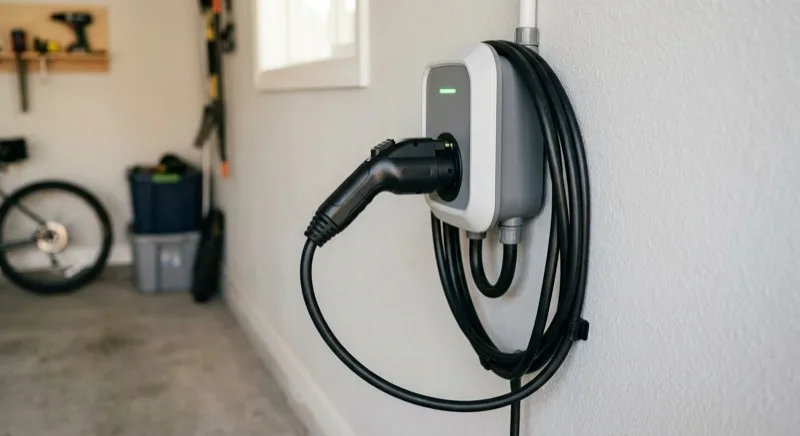
- Inspect the charging cable periodically. Check the Type 2 connector at both ends for any signs of damage, bent pins, or discolouration at the connector collar. Minor wear is normal; charring, cracking, or deformation is not, so contact your installer or the charger manufacturer.
- Don’t ignore tripped breakers. If the dedicated circuit breaker or RCD/RCBO trips repeatedly, that’s the system working as intended, and it’s telling you something is wrong. Don’t simply reset it and carry on; get the circuit inspected.
- Register the charger with the manufacturer. This keeps you in the loop for any firmware updates or safety notices, particularly relevant for smart chargers with network connectivity.
- Use a charger that meets NZ standards. Any charger sold legitimately for the NZ market should carry appropriate certification. Your installer can confirm this if you’re uncertain about a unit you’ve sourced independently.
What to check before your installer visits
You don’t need to diagnose anything yourself. That’s what the Registered Electrician is for. But a few things are worth noting before the quote visit:
- Approximate cable run distance from your switchboard to your planned parking location. A short run through a garage wall is very different from a long exterior run across a property.
- Whether you have single-phase or three-phase power. Check your power bill or the mains connection at your switchboard. A three-phase supply has three conductors plus neutral; a single-phase supply has one active plus neutral. Your network company can confirm if you’re unsure.
- The age and condition of your switchboard. If you can see ceramic fuses rather than modern switch-style breakers, flag this early, as it may affect the quote.
- Indoor or outdoor installation. The charger’s IP (ingress protection) rating matters if it’ll be exposed to weather, and the cable route may be more involved for an outdoor installation.
None of this is required before requesting a quote. It’s just useful context that helps an installer give you an accurate first estimate rather than a ballpark subject to inspection.
What to send for an accurate quote
Include these when you request a quote:
- A photo of your switchboard (open door, full board visible)
- A photo of your parking area or garage from the direction of the house
- Approximate cable route from switchboard to parking: through a garage wall, or a longer run?
- Your EV make and model (affects charger recommendation and connector type)
- Whether you have single-phase or three-phase power
- Any charger brand or model you have in mind
- Preferred timing
The more detail you include, the more accurately an installer can price the job upfront, and the less likely anything is to surface as a surprise once work begins.
See the EV charger installation cost guide for what a typical 7kW dedicated-circuit installation costs in NZ (indicatively ~$1,500–$2,500 all-in for a standard job, before any switchboard work).
Frequently asked questions
Is it safe to charge an EV at home in NZ?
Yes. When the charger is installed on a dedicated circuit by a Registered Electrician with the correct RCD/RCBO protection, home EV charging is safe and routine. The risks come from improvised setups: extension leads, multi-box adaptors, or sustained charging from an old 3-pin socket circuit not rated for the load.
Why can't I just use a standard 3-pin socket to charge my EV?
A standard 3-pin socket and the circuit behind it are designed for intermittent loads, not sustained high-power draw over many hours. Charging an EV overnight at even a modest rate pushes a 10A socket circuit toward its continuous-rated limit. Old or poorly maintained socket wiring is particularly at risk. A dedicated circuit with modern protection is safer and will also charge your car significantly faster.
What is a dedicated circuit and why does my EV charger need one?
A dedicated circuit is a breaker and cable run used only for the EV charger, and nothing else shares it. EV chargers draw sustained power for extended periods, unlike most household appliances. A dedicated circuit ensures the wiring and protection are sized correctly for that sustained load. The EWRB recommends that permanently connected EV charging equipment runs on a dedicated subcircuit rated for the load (especially above 15A), and the installer must ensure the incoming mains aren't overloaded. Your Registered Electrician then certifies the finished work with a Certificate of Compliance.
What does RCD/RCBO protection do on an EV charger circuit?
An RCD (residual current device) or combined RCBO detects tiny imbalances in current (the kind caused by an insulation fault or an unintended earth path) and trips the circuit before that current can cause harm. Modern EV chargers include a degree of onboard protection, but the circuit itself still requires this protection at the switchboard as part of NZ wiring standards.
Do I need a Certificate of Compliance for an EV charger installation?
Yes. EV charger installation is prescribed electrical work under NZ regulations, which means it must be carried out by a Registered Electrician who then issues a Certificate of Compliance (CoC) for the work. The CoC confirms the installation meets the required standard and is your record that it was done correctly. You should always ask for it.
Can I use an extension lead to charge my EV temporarily?
Only as an absolute short-term last resort, and only with a heavy-duty outdoor-rated extension lead of appropriate length and cable gauge, never a domestic multi-box or a light household extension cord. Even then, sustained overnight charging via an extension lead is not recommended. A purpose-installed dedicated circuit is the right long-term solution.