Running cost
EV vs petrol running costs in NZ: is an EV still cheaper now it pays RUC?
Now that light EVs pay road user charges in New Zealand, is home charging still cheaper than petrol? The honest maths, with realistic 2026 numbers you can model yourself.
In short
Yes: for most drivers an EV charged at home is still clearly cheaper to run than petrol, even after road user charges (RUC). Light EVs now pay $76 per 1,000km in RUC, but overnight home charging on an off-peak or EV plan is so much cheaper per kilometre than petrol that the total still comes out well ahead. Model your own numbers with the running-cost calculator below.
Now that light EVs pay road user charges (RUC) in New Zealand, the obvious question is whether an EV is still cheaper to run than a petrol car. The short answer is yes for most drivers, but the honest version is worth the detail, because RUC has narrowed the gap and the maths depends on how you charge. This guide lays out realistic 2026 numbers and points you to a calculator so you can model your own.
The short answer
For a typical driver charging at home, an EV is still clearly cheaper to run than petrol, even after RUC. RUC adds a real, fixed cost per kilometre, but the electricity to cover those kilometres, charged overnight on an off-peak or EV plan, is so much cheaper than petrol that the total still comes out well ahead. The saving is smaller than it was during the EV exemption, but it hasn’t disappeared.
Where it gets closer: very low annual mileage (you barely benefit from the cheaper “fuel”, so the fixed cost of the car matters more) and relying on expensive public rapid charging instead of home charging. Charge at home overnight and the case stays strong.
What changed: EVs now pay road user charges
For years, light EVs were exempt from RUC while the technology got established. That exemption was always temporary (set to end once EVs reached a small share of the fleet), and light EVs now pay RUC like diesel vehicles do (NZTA, verified July 2026):
| Vehicle type | RUC rate |
|---|---|
| Light battery EV (1001–3500kg) | $76 per 1,000km |
| Plug-in hybrid (PHEV) | $38 per 1,000km (reduced: already pays some fuel excise) |
| Plug-in diesel hybrid | $76 per 1,000km |
| Very light EV (under 1000kg) | Not required to buy RUC |
Rates from NZTA (Source), verified July 2026. You buy RUC in advance for a block of distance, so the annual cost is simply your yearly kilometres at the rate above.
Why it exists. Petrol drivers already pay for roads through fuel excise duty baked into the pump price. An EV buys no petrol, so RUC is how it now contributes its share of road upkeep: a road-funding change, not a penalty aimed at EVs.
The honest maths: a year of driving
Here’s an illustrative comparison for 15,000km a year, roughly the national average. These are modelled figures with stated assumptions, not quotes or guarantees; fuel and power prices move, and your car’s efficiency and your power plan change the result. See what it costs to charge an EV at home for your own car and driving.
| EV (home charging) | Petrol | |
|---|---|---|
| ”Fuel” per year | ~$510 electricity | ~$3,375 petrol |
| Road funding | ~$1,140 RUC | included in pump price |
| Approx. total / year | ~$1,650 | ~$3,375 |
Assumptions (illustrative): EV using ~18.5kWh/100km measured at the wall (real-world consumption plus AC charging losses) charged overnight at ~18.5c/kWh on an off-peak/EV plan; petrol car at ~7.5L/100km and ~$3.00/L (fuel excise already included in that pump price); 15,000km/year; RUC at $76/1,000km. Rates verified July 2026. Servicing, tyres, insurance and depreciation are excluded; this is running cost only.
On these figures the EV still saves on the order of $1,700 a year even after RUC. Drive less and both the petrol saving and the RUC shrink, so the gap narrows; drive more and the EV’s cheaper per-kilometre “fuel” pulls further ahead of petrol despite the extra RUC.
Why home charging still wins
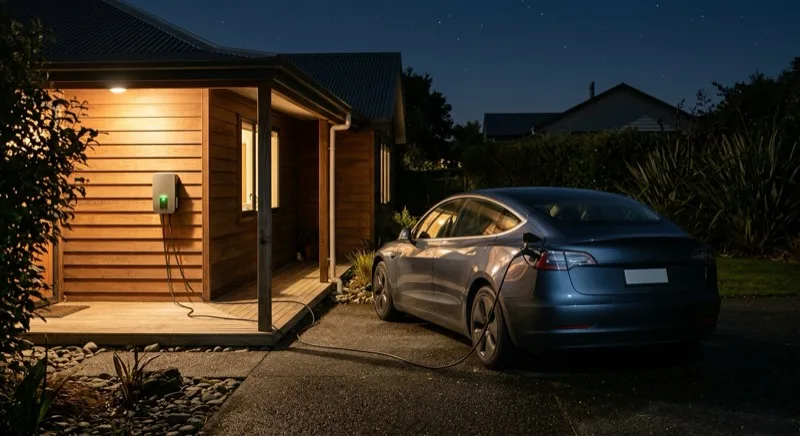
The reason the EV column stays low is entirely about how and when you charge:
- Overnight, off-peak. Pairing a smart charger with an off-peak or EV power plan, so charging starts automatically in the cheap window, is the single biggest lever on EV running cost. This is what makes the per-kilometre electricity cost a fraction of petrol.
- Home, not public. Public rapid charging costs far more per kWh than home charging. It’s the right tool for road trips, but relying on it for everyday charging erodes the savings, so keep daily top-ups at home.
- Solar, if you have it. A solar-diverting charger can charge from surplus generation you’d otherwise export cheaply, pushing your effective “fuel” cost lower again.
If you want the full picture of day-to-day charging and what it costs to run, see the home EV charging guide.
How to actually cut your running cost
- Get a proper home charger installed. A 7kW wall-mounted charger on a dedicated circuit lets you charge overnight at the cheapest rates, the foundation of low running cost. A typical install is around $1,500–$2,500 all-in (indicative); see the installation guide and the cost guide.
- Move to an off-peak or EV power plan and schedule charging into the cheap window with a smart charger. Compare plans in the EV power plans guide.
- Keep everyday charging at home and save public rapid charging for trips.
- Model your real numbers. Your mileage, car and plan decide the outcome, so the running-cost calculator gives you a figure for your situation rather than a national average.
The takeaway: RUC has trimmed the EV running-cost advantage, but for anyone charging at home on a sensible plan it’s still a clear win. If you’re ready to set up cheap home charging, request quotes from local Registered Electricians and we’ll match you with installers who can price your actual home setup.
Frequently asked questions
Do EVs pay road user charges in New Zealand?
Yes. Light battery EVs (1001–3500kg) now pay road user charges (RUC) at $76 per 1,000km, the same base rate as a diesel vehicle. Plug-in hybrids pay a reduced $38 per 1,000km because they already pay some fuel excise duty on the petrol they buy. Very light EVs under 1000kg are not required to buy RUC. You buy RUC in advance in blocks of distance and display or record it against your vehicle.
Is an EV still cheaper to run than petrol after RUC?
For most drivers, yes. RUC adds roughly $1,140 a year at 15,000km, but the electricity to drive those same kilometres (charged overnight on an off-peak or EV plan) is usually only a few hundred dollars, versus a couple of thousand dollars of petrol. Even after adding RUC, the EV total generally lands well below the petrol total. The gap is smaller than it was before RUC, but it's still a real saving for typical mileage.
How much is RUC for an EV per year?
It depends entirely on how far you drive, because RUC is charged per kilometre. At $76 per 1,000km, 10,000km a year is about $760, 15,000km is about $1,140, and 20,000km is about $1,520. Low-mileage drivers pay very little RUC; high-mileage drivers pay more, which is the point of a distance-based charge.
Why do EVs have to pay RUC now?
Petrol drivers pay for road maintenance through fuel excise duty built into the pump price. EVs buy no petrol, so they were temporarily exempt from that road-funding contribution. RUC replaces that missing contribution with a distance-based charge, so EVs pay their share of road upkeep like diesel vehicles always have. It's a road-funding change, not a penalty on EVs, and home charging is still far cheaper per kilometre than petrol.
What's the cheapest way to run an EV in NZ?
Charge at home, overnight, on an off-peak or dedicated EV power plan, using a smart charger set to start in the cheap window. That combination gives you the lowest cost per kilometre, often a fraction of petrol. Public rapid charging is far more expensive per kWh and is best kept for road trips, not everyday top-ups.