Buyer's guide
12 questions to ask before you book an EV charger installer
The questions that separate a good EV charger installer from a cheap one in NZ, what a good answer sounds like, and the answers that mean keep looking.
In short
Before booking, confirm the electrician holds a current practising licence, will issue a Certificate of Compliance, will assess your switchboard capacity, and has installed EV chargers before. Then pin down scope: the charger model, the cable run, RCD protection, commissioning, and what happens to the price if a switchboard upgrade turns out to be needed.
There is no separate EV-charger licence in New Zealand. Any Registered Electrician with a current practising licence may legally install your charger, which means the legal bar and the competence bar are not the same thing, and only one of them gets checked for you.
These are the questions that close that gap. Ask them on the phone or by email before you book. A good installer answers all twelve without hesitation.
The four that are non-negotiable
1. “Do you hold a current practising licence, and what is your licence number?”
Why it matters. Registration and a practising licence are not the same, and it is the licence that authorises the work. The EWRB is explicit: “All electrical workers must hold a Practising Licence to carry out prescribed electrical work” (EWRB, practising licence, verified September 2026). It also has to be current.
What good sounds like. They give you the number without fuss. You can then check it yourself on the Electrical Workers Public Register at kete.mbie.govt.nz, which the Electrical Workers Registration Board maintains so consumers can confirm an electrical worker is “licenced and working legitimately” (EWRB for consumers, verified September 2026).
Red flag. Vagueness, deflection, or “the boss is registered”. The person doing the work is who matters.
2. “Will you issue a Certificate of Compliance, and is it included in the price?”
Why it matters. EV charger installation is prescribed electrical work under the Electricity (Safety) Regulations 2010. A Certificate of Compliance is required, not optional, and it is what your insurer will want to see if there is ever a claim involving the installation.
What good sounds like. “Yes, of course, you will get it by email when we finish.” It should be treated as ordinary.
Red flag. Any hesitation, any suggestion it costs extra, any suggestion it is not needed for “a simple job”. Walk away. More detail in the Certificate of Compliance guide.
3. “Will you assess my switchboard capacity before quoting?”
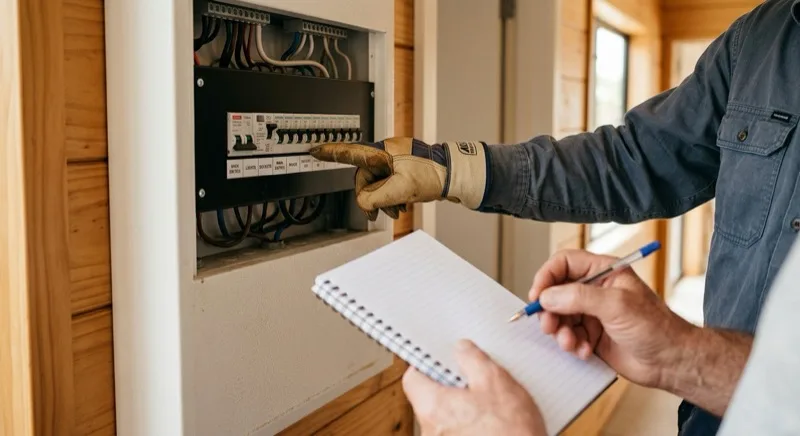
Why it matters. A 7kW charger draws around 32A continuously and is often the single largest load in the house. Whether your board can take it is the biggest variable in both the price and the timeline, and a switchboard upgrade commonly adds $1,500–$3,000.
What good sounds like. They ask for a photo of your switchboard with the door open, or they want to see it in person, before giving you a firm number.
Red flag. A confident fixed price offered over the phone with no interest in your board. That price will change. See do I need a switchboard upgrade?
4. “Will the charger run on its own dedicated circuit, and what RCD protection will you fit?”
Why it matters. A home charger should be supplied from a dedicated final sub-circuit, not shared with your existing power or lighting. WorkSafe’s consumer guidance says the most appropriate protection for EV charging is a Type B RCD, and warns that “the more common Type A RCD that are found already installed in many houses are not suitable” (WorkSafe, safely charging your electric vehicle at home, verified September 2026).
What good sounds like. A specific answer about a dedicated circuit and the RCD type they intend to use, given without you having to push.
Red flag. An offer to run the charger off an existing general-purpose circuit to save money.
The four about competence
5. “How many EV chargers have you installed, and how recently?”
You are listening for regular, current work, not “I did one for my brother-in-law”. An installer who does these weekly has met the failure modes already.
6. “Have you installed this brand before?”
Modern smart chargers need network setup, app pairing and load-management configuration after the physical work. That is part commissioning, part tech setup, and it varies a lot by brand. Someone who has done your specific model before will finish it properly rather than leaving you with a mounted box and a login problem.
7. “Can you handle load management if my board is borderline?”
Where a switchboard is close to its limit, load management can automatically throttle the charger when the rest of the house is drawing heavily. It can sometimes avoid a switchboard upgrade entirely, which is a saving worth thousands. Not every electrician configures it, and not every charger supports it well.
8. “Where would you put the charger, and will the cable reach my car’s port?”
A good installer asks which side your charge port is on and how you park. This is the question most people forget, and a charger mounted two metres from the right spot is a daily irritation for the life of the car. Ask them to mark the position and check it with your car parked normally before anything is drilled.
The four about the deal
9. “Is this a quote or an estimate?”
In New Zealand these are legally different. A quote is a fixed price the provider cannot exceed without your agreement; an estimate is a best guess that should land within roughly 10 to 15 percent (Consumer Protection, quotes and estimates, verified September 2026). Get it in writing, and get it as a quote.
10. “What exactly is included, and what would cost extra?”
Charger and model, cable run length and routing, the circuit and its protection, mounting and weatherproofing, commissioning and app setup, the Certificate of Compliance, GST, and travel. Then the important half: what specifically would trigger an extra charge, and how it would be agreed with you. The full checklist is in how to read and compare EV charger quotes.
11. “What warranty do you give on your workmanship, and what happens if the charger faults?”
Two different things. The charger has a manufacturer’s warranty; the installation has the electrician’s workmanship warranty. Find out how long each runs and, crucially, who you call first if the unit stops working in eighteen months. Getting a straight answer now saves a finger-pointing exercise later.
12. “How long will it take, and will my power be off?”
A straightforward install is usually two to four hours, with the switchboard isolated for perhaps 30 to 60 minutes of that. If you work from home or have anything on mains power that cannot simply stop, this is the question that lets you plan. See what to expect on install day.
The short version
If you only ask four, ask these:
- What is your practising licence number?
- Is the Certificate of Compliance included?
- Have you looked at my switchboard, and what happens to the price if it needs upgrading?
- Is this a fixed quote, and what exactly does it include?
An experienced EV installer answers all four in under a minute and is not bothered that you asked. That reaction is itself part of the answer.
Make it easy to get good answers
Installers give sharper answers when they have real information. Send the same details to everyone you approach:
- A clear photo of your switchboard, door open if it is safe to do so.
- A photo of the parking area and roughly where you want the charger.
- The approximate distance between the two.
- Your EV model, and whether your supply is single-phase or three-phase if you know.
- Any charger preference, or say you would like a recommendation.
That package turns a vague ballpark into a real quote, and it lets you compare installers on the things that actually differ.
Frequently asked questions
How do I check an electrician is licensed in New Zealand?
Search the Electrical Workers Public Register, run by the Electrical Workers Registration Board, at kete.mbie.govt.nz. Ask for the electrician's name or licence number and check both that they are registered and that they hold a current practising licence. Registration on its own is not authority to work; the practising licence is what makes the work legal.
What questions should I ask an EV charger installer before booking?
Ask whether they hold a current practising licence, how many EV chargers they have installed, whether they will assess your switchboard capacity, whether a Certificate of Compliance is included, what RCD protection they will fit, what the quote covers if a switchboard upgrade is needed, whether commissioning and app setup are included, and what warranty applies to their workmanship.
Does an EV charger installer need a special EV qualification in NZ?
No. There is no separate EV-charger licence in New Zealand. Any Registered Electrician with a current practising licence may legally do the work. That is exactly why the experience question matters: the legal bar and the competence bar are not the same, and only one of them is checked for you.
What are the red flags when choosing an EV charger installer?
No mention of a Certificate of Compliance, reluctance to give a licence number, quoting without seeing or asking about your switchboard, offering to wire the charger off an existing general-purpose circuit, no written quote, and pressure to pay the full amount in cash up front.
Should I use the installer my charger supplier recommends?
Often yes, since manufacturer-accredited installers know that product's commissioning and warranty process. It is still worth getting a second quote to check the price is competitive, and the same questions apply. Accreditation with a brand is not a substitute for a current practising licence and a Certificate of Compliance.
Is it worth paying more for a more experienced EV charger installer?
Usually, if the difference is modest. The costly mistakes in this job are an undersized or shared circuit, a missed switchboard capacity problem, a charger mounted where the cable will not reach the car's port, and a charger that is never properly commissioned. Those are experience problems, and fixing them afterwards costs more than the original gap.