Buyer's guide
How to read and compare EV charger installation quotes
Why two quotes for the same EV charger differ by $1,000, what a complete quote should itemise, and the NZ legal difference between a quote and an estimate.
In short
In New Zealand a quote is a fixed price the provider cannot exceed without your agreement, while an estimate is only a best guess. Ask for a written quote, then compare on scope rather than price: the charger model, the cable run, the circuit protection, whether a switchboard upgrade is included, and whether commissioning and the Certificate of Compliance are in the number.
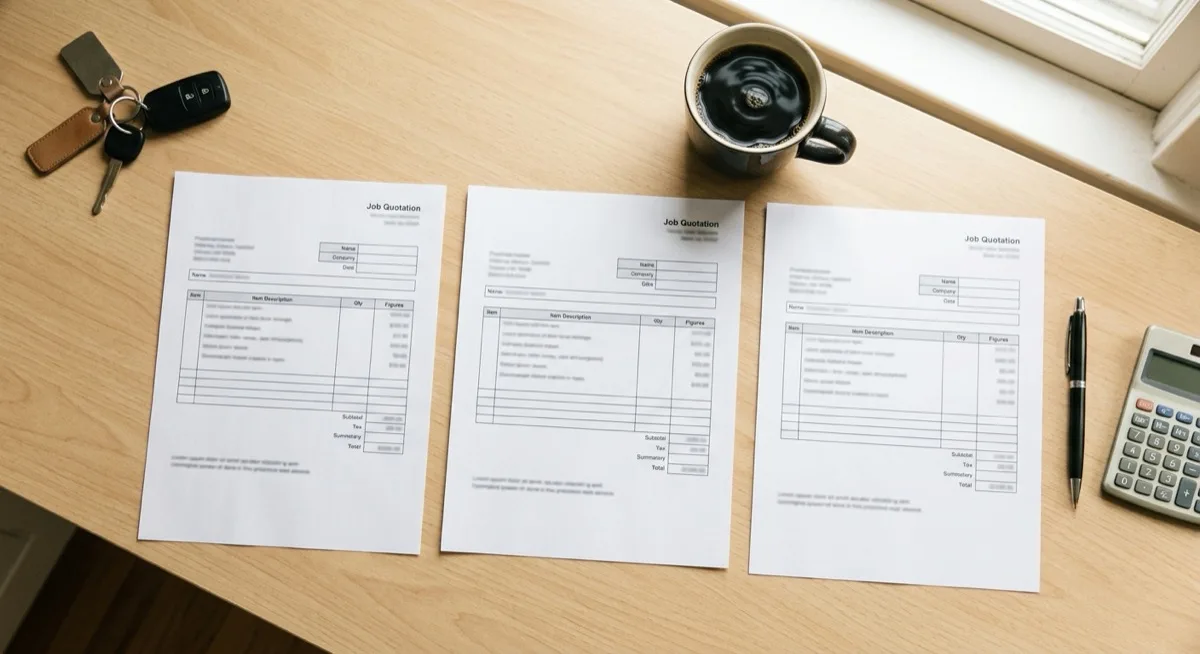
Three quotes arrive. One says $1,380, one says $2,400, one says $3,900. They are supposedly for the same job. Here is how to work out which of them is actually comparable, and which is cheap because it has left something out.
First: is it a quote, or an estimate?
In New Zealand these are two different things, and the difference is a consumer protection, not a formality.
A quote is a fixed price. Consumer Protection NZ puts it plainly: “If you have been given a fixed quote, the service provider must complete the work within the quoted cost, unless you agree to a variation.” Once you accept a quote, the provider cannot charge you more unless you agree to extra work or the scope of the job changes (Consumer Protection, quotes and estimates, verified September 2026).
An estimate is a best guess. It is the provider’s view of the likely cost based on experience. There is no legal difference between a verbal and a written estimate, and the final total “should generally be within 10 to 15 percent” of it (same source).
So the first question to ask about any document you receive is which one it is. If it does not say, ask. For a job of this size, get it in writing as a quote.
Consumer Protection also sets out what a quote or estimate should show: what work will be done, any other costs such as materials, the hourly rate for the people doing the work, and how long the work will take. If a document you have been sent is just a figure and a business name, it is not enough to compare against anything.
What a complete EV charger quote should itemise
Use this as your checklist. A quote that covers all of it can be compared with another that covers all of it. Anything missing is not necessarily dishonest, but it is a question to ask.
- The charger. Make, model, power rating, and tethered or untethered. “7kW smart charger” is not a model. And confirm whether the charger is even in the price, or whether you are buying it separately.
- The cable run. The assumed distance from switchboard to charger, and how it is routed: surface conduit, in a wall cavity, through the ceiling, or buried. This is the biggest variable in the whole job and the most common reason two quotes diverge.
- The dedicated circuit and its protection. WorkSafe’s guidelines say a home charging station should run on its own dedicated final sub-circuit, with RCD protection suitable for EV charging, rather than sharing your existing power circuits.
- The switchboard. Either an upgrade is included and priced, or the quote states it is excluded and says what happens if one turns out to be needed.
- Mounting and making good. Bracket, fixings, weatherproofing for an outdoor install, and any patching or sealing.
- Commissioning. Powering up, testing, connecting a smart charger to your Wi-Fi, pairing the app, and setting current limits or load management.
- The Certificate of Compliance. It is legally required, so it should never be an optional extra, but it should be named.
- GST. Check every quote is on the same side of it. A GST-exclusive quote against a GST-inclusive one is a 15 percent phantom difference.
- Travel or call-out, if it is charged separately.
- How long the quote is valid, and the payment terms.
Why two honest quotes still differ by $1,000
Most of the gap between two legitimate quotes comes from four places.
Different charger. Home wallboxes range widely on price. A basic unit and a premium solar-diverting one are different products, and a quote built on each will never match. Compare the install labour separately from the hardware if you can.
Different cable assumption. One electrician has assumed a 5 metre run along an internal garage wall. The other has walked the site and priced 18 metres with a section in conduit outside. The second is more expensive and more likely to be right.
Switchboard in or out. This is the big one. A switchboard upgrade commonly adds $1,500–$3,000 on top of the install, so a quote that includes one and a quote that excludes one are not remotely comparable. If your board is older or full, treat any quote that does not mention it as incomplete. See do I need a switchboard upgrade?.
Single-phase versus three-phase. An 11kW or 22kW charger needs three-phase supply. If one quote is for a 7kW single-phase unit and another for a 22kW three-phase one, you are comparing two different projects.
For context, a typical 7kW wall-mounted install in New Zealand lands around $1,500–$2,500 all in. That is a range, not a promise, and your switchboard and cable run move it. A quote well below that range is not automatically wrong, but it is worth asking exactly what it covers.
What a suspiciously cheap quote is usually missing
Work through these before you accept the lowest number:
- The charger is not in it. Supply-and-install versus install-only is the single most common reason a quote looks dramatically cheaper.
- GST is not in it.
- Commissioning is not in it, so the charger gets mounted and energised but you are on your own for the app, the schedule and the current limit.
- A short cable run has been assumed without anyone looking at your property.
- No switchboard assessment has happened. If nobody asked for a photo of your board or looked at it, the quote is built on a guess.
- No Certificate of Compliance is mentioned. This one is not a pricing question, it is a walk-away question. See can any electrician install an EV charger?
Provisional sums and the switchboard unknown
Sometimes an electrician genuinely cannot price part of the job until they open something up. A provisional sum is a labelled placeholder for that work, and seeing one is a sign of care rather than evasion.
What makes a provisional sum acceptable:
- It is clearly labelled as provisional, not buried in the total.
- The quote says what would trigger it, for example “if the existing board has no spare ways”.
- The final figure is agreed with you before the work is done.
What makes one a problem: a vague “extra work charged at cost” line with no cap, no trigger, and no agreement step. That is not a fixed quote, whatever the heading says.
Comparing like for like

A practical way to do it. Put the three quotes side by side and answer these for each:
- Is this a quote or an estimate?
- Same charger make, model and power rating?
- Same assumed cable run length and routing method?
- Is a switchboard upgrade included, excluded, or provisional?
- Is commissioning and app setup included?
- Is the Certificate of Compliance named?
- All GST-inclusive, or all GST-exclusive?
- Same warranty on workmanship, and same charger warranty?
If two quotes answer those eight identically, the cheaper one is genuinely cheaper. If they do not, go back to each installer and ask them to re-quote on the same scope. A good electrician will not mind. It is a normal request, and it is far cheaper than discovering the gap on install day.
If the final bill is higher than the quote
For a fixed quote, the work has to be completed within the quoted cost unless you agreed to a variation. If a bill arrives higher than the quote and you did not agree to extra work in advance, raise it in writing with the installer first and refer to the quote you accepted. Consumer Protection NZ’s guidance on quotes and estimates, and on overcharging, sets out where you stand.
The practical defence is earlier than that, though: agree variations before the work happens, in writing, even if it is only a text message confirming the extra amount. Install day is not the moment to be negotiating price with a wall already drilled. What happens on the day is covered in what to expect on install day.
Getting quotes that are comparable in the first place
The reason quotes vary so much is that installers are often working from different information. Give all of them the same brief and the spread narrows dramatically:
- A clear photo of your switchboard, door open if it is safe to do so.
- A photo of the parking area with roughly where you want the charger.
- Your best estimate of the distance from switchboard to that spot.
- Your EV model, and whether you have single-phase or three-phase supply if you know.
- Any charger preference, or “no preference” if you want them to recommend.
Send that same package to everyone you ask, and you will get quotes you can actually put next to each other.
Frequently asked questions
What is the difference between a quote and an estimate in New Zealand?
A quote is an offer to do the job for a specified price. Consumer Protection NZ says that once you accept a quote the provider cannot charge you more unless you agree to extra work or the scope changes. An estimate is only the provider's best guess based on experience, and the final cost should generally land within about 10 to 15 percent of it. For an EV charger install, ask for a written quote.
What should an EV charger installation quote include?
The charger make and model, the cable run length and how it will be routed, the new dedicated circuit and its RCD protection, mounting and any weatherproofing, commissioning and app setup, the Certificate of Compliance, GST, and either a switchboard upgrade or a clear statement of what happens if one turns out to be needed.
Why are EV charger quotes so different for the same job?
Usually scope, not margin. The common causes are a different charger model, a different assumption about the cable run, one quote including a switchboard upgrade the other has left out, one excluding GST, and one treating commissioning as an extra. Compare the inclusions line by line before you compare the totals.
Can an electrician charge more than the quoted price in NZ?
Not for the quoted scope. Consumer Protection NZ states that if you have been given a fixed quote, the service provider must complete the work within the quoted cost unless you agree to a variation. If extra work is genuinely needed, they should stop, explain it, and get your agreement in writing before continuing.
Is the cheapest EV charger quote usually a false economy?
Not always, but check what is missing before you accept it. A materially cheaper quote often excludes GST, excludes the charger itself, assumes a shorter cable run, leaves out commissioning, or has not accounted for a switchboard that cannot take the load. A cheap quote built on the same scope as an expensive one is a genuine saving.
What is a provisional sum on an EV charger quote?
It is a placeholder amount for work that cannot be priced until something is opened up or inspected, most often the switchboard. It is a reasonable thing to see on a quote. What matters is that it is labelled clearly, that you are told what would trigger it, and that the final amount is agreed with you before the work is done rather than after.