Guide
How much power does an electric home need in New Zealand?
Water heating is 30% of a NZ home's energy use, and a 7kW EV charger adds 32A. How to tell if your supply carries both, and what to do if it can't.
In short
Most NZ homes on single-phase power can add a 7kW EV charger without trouble, but stacking several big electric appliances (EV, heat pump, hot-water heat pump, induction cooktop) can push a home past its supply capacity. A Registered Electrician works out your maximum demand and tells you whether load management, a switchboard change, or a supply upgrade is needed.
If you’re electrifying your home one appliance at a time, an EV charger now, maybe a heat pump, a hot-water heat pump and an induction cooktop later, they all draw on the same electricity supply. At some point the sensible question stops being “will this one appliance fit?” and becomes “does my house have enough power for all of it?”
Short answer
Most NZ homes on single-phase power can add a 7kW EV charger with no drama. The question gets real when you stack several high-draw electric appliances on one supply. An EV charger, a space-heating heat pump, a hot-water heat pump and an induction cooktop together can approach what a typical single-phase connection is designed to carry.
The good news: they rarely all run at full power at the same instant, so you usually have more room than the appliance labels suggest. The only way to know for certain is to have a Registered Electrician work out your home’s maximum demand. Depending on the result, the fix is load management, a switchboard upgrade, or a supply upgrade, in that rough order of cost.
The “six machines” of an electric home
Groups like Rewiring Aotearoa describe a fully electric home as roughly six machines: space heating, water heating, cooking, transport, and (optionally) solar generation and battery storage (Rewiring Aotearoa electrification guides, verified July 2026). Four of them are meaningful electrical loads you might add over time:
- EV charger. A standard 7kW wall-mounted charger draws about 32A on single-phase, sustained for hours. It’s usually the single biggest new load in a home.
- Space-heating heat pump. Efficient, but a ducted or larger system still adds a dedicated circuit and a few kilowatts at peak.
- Hot-water heat pump. Replaces an electric cylinder; modest running draw but its own circuit.
- Induction cooktop. A full cooktop can draw heavily for short bursts, up to around 32A for a large four-zone unit running several zones at once.
Each of these is a large appliance that generally needs its own dedicated circuit at the switchboard, not a shared one. Indicative install costs vary widely: Rewiring Aotearoa puts a heat pump or hot-water heat pump around $3,000–$10,000 and an induction cooktop around $3,000–$5,000 installed (Rewiring Aotearoa, verified July 2026), and a typical 7kW charger install sits around $1,500–$2,500 (see the installation cost guide). These are ranges, not quotes; your electrician confirms for your home.
Hot water: the big load you already have
Most of this guide is about appliances you are thinking of adding. Water heating is the one you almost certainly already have, and it is larger than people expect: about 30% of the average New Zealand household’s energy use (EECA, verified August 2026).
An electric storage cylinder is a simple thing electrically. A heating element on its own dedicated circuit reheats the tank in blocks after you have drawn hot water off it, rather than running continuously.
Here is the part that matters for capacity, and that most homeowners have never been told: your cylinder is probably not free to run whenever it likes. All 29 electricity distribution businesses in New Zealand operate ripple control, and just over half of electricity consumers have it, most of that connected to hot water systems. The load under ripple control equates to roughly 15% of New Zealand’s annual peak demand (EECA, Ripple Control of Hot Water in New Zealand, September 2020, verified August 2026). Your lines company sends a signal that switches those cylinders off while the network is busy.
So if your hot water sits on a controlled circuit, load-shifting is already happening on your behalf, and it is part of why your existing supply copes. That share is slowly declining, partly because solar installers disconnect water heating from ripple relays to use the generation on site. Worth knowing before you assume the arrangement stays as it is.
Swapping an electric cylinder for a hot-water heat pump
A hot-water heat pump does the same job with far less electricity. Instead of turning power straight into heat with an element, it moves heat from the outside air into the tank. That is why it reaches a coefficient of performance of roughly 2 to 4 depending on the model, and uses around 60 to 75% less electricity than a conventional electric cylinder (EECA, verified August 2026).
What that is worth over a year depends on your household. EECA’s figure for a three-person Auckland home switching from a traditional electric cylinder is a saving of around $284 a year (EECA, verified August 2026).
The trade is up front. EECA puts a hot-water heat pump at roughly $7,000 to $7,500 to buy and install, against about $3,000 to $4,000 for a replacement electric cylinder (EECA and EECA and EECA, verified August 2026). Treat those as indicative rather than a quote: EECA states different figures on different pages, which is a fair reminder that your home decides the rest.
Life expectancy is where the marketing and the evidence part company. One EECA page says around 15 years (EECA, verified August 2026), but EECA’s own research page puts hot-water heat pumps at 8 to 15 years, and notes that is shorter than the 10 to 15 years a standard electric resistance cylinder tends to last (EECA, verified August 2026). Take the lower end when you do the payback arithmetic, not the higher one.
The honest downsides, also from EECA’s research page: it is less efficient in cold weather, which is exactly when you want hot water most, and it is louder than a cylinder because it has a fan and a compressor (EECA, verified August 2026). Many units sit outdoors, which frees up the cupboard but can put the noise against a wall someone sleeps behind. Decide where it goes before you commit.
Electrically this is not a like-for-like swap. The unit needs its own suitably rated circuit at the switchboard, and if it replaces a cylinder that was on a controlled circuit, whether it stays on that arrangement is a question for your electrician and your retailer rather than an assumption. All of it is prescribed electrical work: it must be carried out by a Registered Electrician and certified with a Certificate of Compliance (Electricity (Safety) Regulations 2010, reg 65, verified August 2026).
It’s about maximum demand, not adding up the labels
The instinct is to add every appliance’s peak rating and panic. That isn’t how supply capacity is assessed. Electricians calculate maximum demand: the realistic peak a home draws once you allow for the fact that not everything runs flat out at the same moment. The oven, the charger, the heat pump and the kettle are almost never all at full power in the same second.
New Zealand follows the AS/NZS 3000 wiring rules, whose maximum-demand tables build in these diversity allowances for each type of load: lighting, socket outlets, ranges and cooktops, water heaters, and (added by Amendment 2 in 2020) EV charging (AS/NZS 3000 maximum demand, Appendix C, verified July 2026). The number that matters is this calculated maximum demand, not the sum of the nameplates, and it’s why many homes can carry more than owners expect.
Single-phase vs three-phase: how much headroom you have
Most NZ homes are on single-phase power: 230V, with a main fuse commonly rated around 63–80A at the point of supply (Neon Electrical, how household electricity works, verified July 2026). That’s enough for everyday appliances plus a 7kW charger in most homes, but it’s a finite ceiling once you start stacking big loads.
Three-phase supply gives you three live conductors instead of one, roughly tripling the capacity available and letting big loads be spread across the phases. It also unlocks faster 11kW or 22kW charging. Converting a home from single- to three-phase runs through your lines company and can be a significant cost, so it’s weighed case by case rather than assumed. For how supply type shapes your charging options specifically, see the single-phase vs three-phase guide.
What happens when you stack the big loads
The tension isn’t any one appliance, it’s the combination on a tight single-phase supply. A worked-through example: a home already running an induction cooktop and a heat pump, then adding a 7kW charger, might be fine on paper by maximum demand, yet still trip or strain if the charger pulls full power during the evening cooking-and- heating peak.
This is exactly where an assessment pays off. The electrician isn’t just checking for a free breaker slot (that’s the switchboard question), they’re checking whether your total peak demand stays under what the supply can safely deliver once the new appliance is in.
Load management: fitting more into the same supply
Where the limit is peak load rather than missing circuit slots or protection, load management (dynamic load balancing) often avoids an upgrade entirely. A current sensor at the mains watches the whole home’s draw and eases the EV charger back when the house gets busy, then lets it speed up again when the oven and heat pump switch off.
It’s particularly useful on single-phase homes with modest headroom, and it’s a feature built into many modern smart chargers. It won’t create circuit slots or fix missing RCD/RCBO protection, but if the only concern is not exceeding the supply at peak, it’s usually the cheapest way to add a big appliance. See the smart charger guide for which chargers include it.
Hot water and EV charging want the same overnight window
This is the one that catches people out when they electrify in stages.
An EV charger and a hot-water system are the two loads in a typical home that are big and shiftable. Neither much cares when it runs, as long as the car is charged by morning and the water is hot when you shower. That flexibility is genuinely valuable, and it is why charging off-peak is cheaper.
It also means both want the same hours. Push your EV charging into the cheap overnight window, leave the cylinder reheating overnight on a controlled circuit, and you have concentrated two of your largest loads into the same few hours on the same supply. Maximum demand is assessed on the peak, and stacking them moves the peak rather than removing it.
None of that is a reason to avoid either. It is a reason to have them talk to each other:
- Load management on the charger handles it directly, easing the car back when the rest of the house is drawing hard. A cylinder reheating counts as the rest of the house.
- A controlled hot-water circuit is already doing a version of this, on your lines company’s schedule rather than yours.
- Charging schedules, set in the car or the charger, can be offset from the reheat window instead of landing on top of it.
If you are adding both, say so when you get the quote. An electrician sizing for a charger alone reaches a different answer than one who knows a hot-water heat pump is coming next year.
When you need a supply upgrade, not just a switchboard
It helps to separate three different limits, because they have three different fixes:
- The board is full or ageing. Fix at the switchboard: add capacity, a dedicated circuit and modern protection. This is the common EV case, covered in the switchboard upgrade guide.
- The peak is too high for the supply. Fix with load management, or by upgrading the supply.
- The incoming supply itself is too small. A supply (mains) upgrade raises the capacity coming into the property, or moves you to three-phase. This one involves your lines company, not just your electrician, so it takes longer and costs more.
Only a Registered Electrician can tell you which of these applies, and any board or supply work is prescribed electrical work that must be certified with a Certificate of Compliance (Electricity (Safety) Regulations 2010, reg 65, verified July 2026).
Planning the order you electrify in
If you’re going to add several of these over a few years, it’s worth having the capacity conversation once, up front, rather than paying for a fresh assessment each time. An electrician can tell you what your current supply comfortably carries, what would tip it over, and whether a single switchboard or supply upgrade now would save repeat work later. That whole-home sequencing is the point of the home electrification starting guide.
How to find out what your home can take
Treat the capacity check as part of the quote for your first big appliance. When you request a quote, it helps to include:
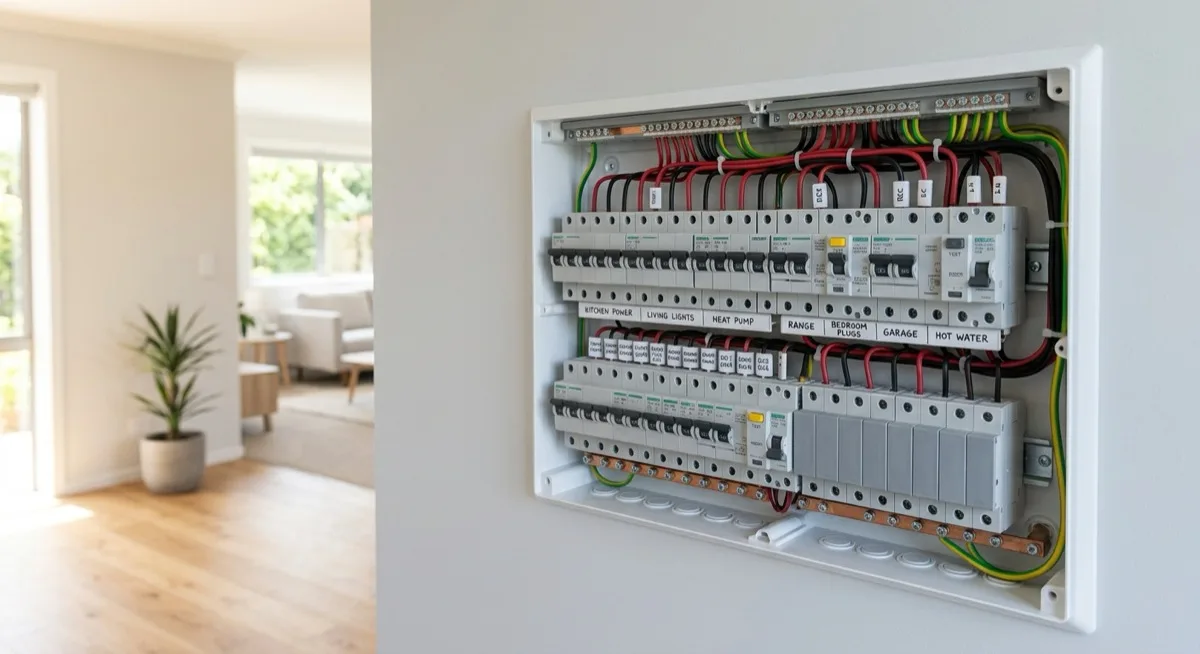
- A photo of your switchboard (door open, whole board visible)
- Whether you have single-phase or three-phase power (check your power bill, or ask your lines company if unsure)
- Which electric appliances you already run (heat pump, induction cooktop, electric or heat-pump hot water)
- Which ones you’re planning to add, and roughly when
- Your EV make and model, and any charger speed you want (7kW, 11kW, 22kW)
The more of this an installer has, the more accurately they can tell you whether your home fits as-is, needs load management, or needs a board or supply upgrade, before any of it becomes a surprise.
Frequently asked questions
How much power does a fully electric home use at once?
Less than the sum of the labels. An EV charger (about 32A), a heat pump, a hot-water heat pump and an induction cooktop rarely all run flat out at the same moment, so an electrician calculates your maximum demand using the diversity allowances in the AS/NZS 3000 wiring rules rather than adding every appliance's peak rating. That figure, not the total, is what your supply has to cover.
Can a single-phase home run an EV charger, heat pump and induction cooktop together?
Often yes, but it depends on your supply. Many NZ homes are on single-phase power with a main fuse commonly rated around 63–80A, which leaves enough headroom for a 7kW charger plus everyday appliances. Add several high-draw items and the total can approach that ceiling. A Registered Electrician assesses whether you fit as-is, need load management, or need more supply.
Do I need three-phase power to electrify my home?
Not usually. Most homes electrify fine on single-phase. Three-phase gives you more total capacity and spreads the load, which helps if you want fast (11kW or 22kW) EV charging alongside other big appliances, or if your single-phase supply is already tight. Converting from single- to three-phase involves your lines company and can be costly, so it's weighed case by case.
What is load management and can it avoid an upgrade?
Load management (also called dynamic load balancing) monitors your home's live power draw and eases back a big appliance, usually the EV charger, when the rest of the house is busy. If the only issue is peak load rather than a lack of circuit slots or missing protection, it can let you add a charger without a supply or board upgrade. It's built into many smart chargers.
Who works out whether my home has enough capacity?
A Registered Electrician. Only they can carry out and certify the work, and a Certificate of Compliance must be issued for prescribed electrical work. Assessing your switchboard, supply type and maximum demand is normally part of the quote, so ask for it up front rather than discovering a limit mid-job.
What if my home doesn't have enough power?
There are three common paths, roughly in order of cost: load management to share a tight supply, a switchboard upgrade to add capacity and protection at the board, or a supply (mains) upgrade through your lines company to raise the incoming capacity. An electrician recommends which fits your home and appliances.
Does a hot water heat pump need its own circuit?
Yes. A hot-water heat pump is a fixed appliance and needs its own suitably rated circuit at the switchboard, not a shared one. If it replaces a cylinder that sat on a controlled (ripple) circuit, whether the new unit stays on that arrangement depends on your lines company and your electricity retailer, so confirm it rather than assuming. Installing or altering that circuit is prescribed electrical work: a Registered Electrician must carry it out and issue a Certificate of Compliance.
Is it worth switching from an electric cylinder to a hot water heat pump?
It depends on how much hot water you use and how long you will stay in the home. A hot-water heat pump uses around 60 to 75% less electricity than a conventional electric cylinder, and EECA estimates a saving of about $284 a year for a three-person Auckland household switching from one. Against that, it costs roughly $7,000 to $7,500 to buy and install compared with about $3,000 to $4,000 for a replacement electric cylinder, and EECA puts its working life at 8 to 15 years, which is shorter than the 10 to 15 years a standard electric cylinder tends to last. It also runs louder, because it has a fan and a compressor, and is less efficient in cold weather. The more hot water your household uses, the faster the running-cost difference closes the gap.
Can I run a hot water heat pump and an EV charger on single-phase power?
Usually yes. Both are moderate continuous loads rather than huge ones, and a typical single-phase supply has room for them alongside everyday appliances. The catch is timing: both are loads people shift into cheap overnight hours, so they can end up running together and creating a new peak. A Registered Electrician calculates your maximum demand with both in the picture, and load management on the charger can keep the total under your supply ceiling without an upgrade.