Guide
Wiring a new build or renovation for EV charging in NZ
Pre-wiring a new build or renovation for an EV charger at the framing stage costs far less than a retrofit. Here's how to make your NZ home EV-ready.
In short
Yes, wire for it now. Running a dedicated circuit and conduit to the garage while the walls are open costs a fraction of a retrofit, which means cutting into finished linings later. Leave spare capacity at the switchboard, settle the single vs three-phase question up front, and have a Registered Electrician do the work.
If you’re building a new home or planning a renovation, the cheapest EV charger you’ll ever install is the one you wire for before the walls close up. Even if an EV is years away, leaving a dedicated circuit ready at the build stage turns a disruptive future retrofit into a quick swap.
Short answer
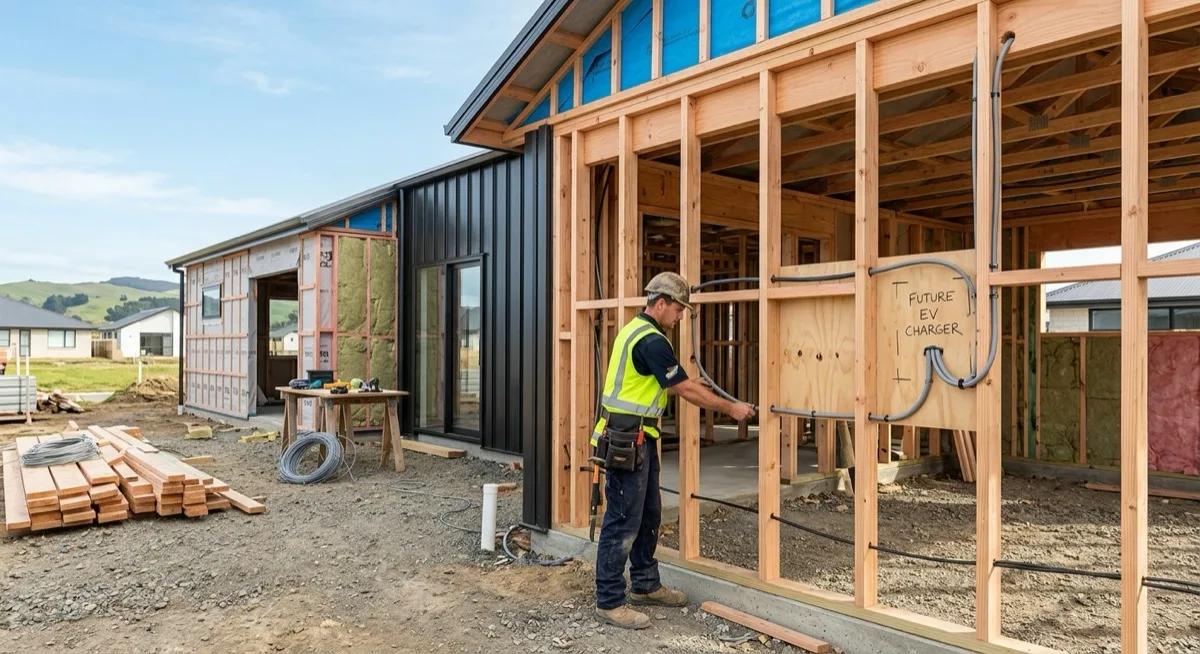
Wire for it now. The single biggest variable in any home charger quote is the cable run from your switchboard to where the car parks. During a build or renovation, that run is close to free: the walls are open, the conduit and cabling are already being pulled, and the electrician is on site. Do it later and the same run means cutting into finished linings, chasing walls, and making good afterwards.
Pre-wiring during a new build results in a more cost-effective installation later (Evnex pre-wiring guide, verified July 2026). The build window is the one moment where making your home EV-ready costs a line item rather than a project.
Why the build stage is the cheap moment
Retrofitting an EV charger into a finished home means cutting into walls, running new cable, and often making good the decorating afterwards. Adding the same infrastructure during a build is a straightforward addition while cables are already being run and walls are still open (David Reid Homes, verified July 2026).
The saving is entirely in access, not hardware. The charger unit itself costs the same whenever you buy it. What the build stage removes is the labour and disruption of getting a cable from the switchboard to the garage or carport through a house that’s already lined and painted. Miss that window and you pay for that access separately, on top of the install.
This is why the advice from EV charger suppliers and new-build electricians is consistent: prepare the wiring solution up front rather than having extra cabling run later (Evnex, verified July 2026).
What “EV-ready” actually means
Making a home EV-ready isn’t about buying a charger early. It’s about leaving the right dedicated circuit in place so the charger can be added with minimal work.
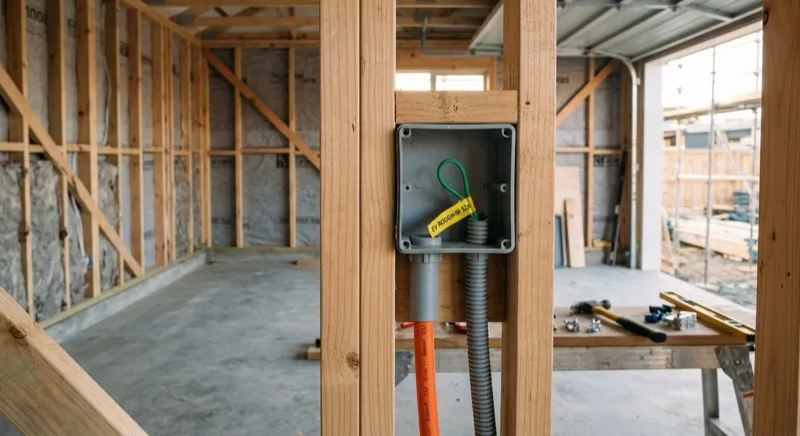
A home EV charger draws substantial, sustained power and needs its own dedicated final sub-circuit back to the switchboard, not a shared one. Evnex’s pre-wire best practice is a dedicated 32A final sub-circuit sized for a single- or three-phase charger, terminated at a flush box about 1.2m from finished floor level where the charger will be mounted (Evnex pre-wiring guide, verified July 2026).
There are two common ways to leave a build EV-ready:
- Run the full circuit now. The dedicated cable is pulled from the switchboard to the charger location and terminated ready for the wallbox. This is the most complete option and suits anyone who knows they’ll fit a charger soon.
- Run conduit and a draw string. If you’re not ready to commit to a charger model, an empty conduit with a draw wire from the switchboard to the parking spot lets the cable be pulled later without opening any walls. This captures the cheap part of the job while deferring the rest.
Either way, the goal is the same: never again pay to open a finished wall just to get a cable across the house.
Leave capacity at the switchboard
Wiring the circuit is only half of it. The switchboard also needs room for the charger, both a free way for the new breaker and enough overall capacity to run it.
A home EV charger can draw a large share of a typical NZ home’s supply. Evnex notes an installed charger can take up to half of a standard home’s 63A capacity (Evnex, verified July 2026). On a new build you get to specify the board, so it’s worth avoiding the cheapest, smallest option. A board with spare ways leaves headroom not just for an EV charger but for the heat pump, solar, or home battery a modern home tends to accumulate.
Getting this right at build stage is far cheaper than the alternative. Upsizing an undersized switchboard after the fact is its own separate job, which is exactly the kind of cost a well-specified board avoids. See the switchboard upgrade guide for what triggers one and what it adds to a retrofit.
Decide single-phase or three-phase up front
The one decision that’s genuinely hard to reverse later is your supply type.
Most NZ homes are single-phase, and a 7kW single-phase charger comfortably recharges almost any EV overnight, adding roughly 40km of range per hour. Three-phase supply unlocks faster 11kW or 22kW charging, but only if your car accepts three-phase AC, and most households never need that speed.
The reason to settle it during the build is cost asymmetry. If you specify three-phase supply while the connection and switchboard are being planned, the incremental cost is modest. Bringing three-phase into a finished single-phase home later is a significant project that can involve the lines company and a new supply, not just internal wiring. If there’s any realistic chance you’ll want faster charging (two EVs sharing a point, a large-battery car with early departures), raise it before the supply is locked in. The full trade-off is covered in the single-phase vs three-phase guide.
Renovations: the same logic, a smaller window
The build-stage advantage isn’t limited to new homes. Any renovation that opens up walls, especially near the garage, carport, or switchboard, is a chance to run the EV circuit while access is free.
If you’re re-lining a garage, replacing a switchboard, adding a room, or rewiring an older home, ask the electrician to price the EV circuit as part of that work. The saving is the same: you’re already paying for the wall to be open, so the marginal cost of pulling one more dedicated cable is small compared with doing it as a standalone retrofit later.
Who does the work, and the compliance side
Wiring a dedicated EV circuit is prescribed electrical work. It must be carried out by a Registered Electrician, and the work cannot be treated as complete until a Certificate of Compliance is issued for it (Electricity (Safety) Regulations 2010, reg 65, verified July 2026). A domestic charging station should also sit on its own dedicated final sub-circuit under WorkSafe’s guidance (WorkSafe EV Charging Safety Guidelines, 2nd ed, verified July 2026), which is exactly what the pre-wire provides.
On a new build, the EV circuit is certified as part of the whole-house electrical work, so there’s no separate process to chase. Keep the paperwork, though: it matters when the charger is finally connected, and it confirms the circuit was installed to standard. Any competent Registered Electrician can do this, but flag the EV requirement early so it’s designed in rather than squeezed in.
What to tell your builder or electrician
Raise EV charging at the electrical planning stage, not after the linings go up. Cover these points:
- Where the car will park, and therefore where the charger should mount. This sets the cable route from the switchboard.
- A dedicated circuit or conduit run to that location, terminated at a flush box around 1.2m off the floor.
- Single-phase or three-phase supply, decided before the connection and switchboard are specified.
- Spare capacity at the switchboard, both a free way for the EV breaker and enough overall headroom for future loads.
- Whether you want a full circuit now or a conduit and draw string to pull cable later without opening walls.
- The Certificate of Compliance for the electrical work, kept with your build documents.
Getting these on the plan early is the difference between a home that’s genuinely EV-ready and one that only looks ready until the first quote reveals a cable run through finished walls.
Frequently asked questions
Is it worth pre-wiring my new build for an EV charger if I don't have an EV yet?
For most people, yes. The expensive part of a home charger install is the cable run from the switchboard to the parking spot. At the framing stage that run is trivial because the walls are open and the electrician is already on site. Retrofitting the same cable later means cutting into finished linings and making good afterwards. Even if an EV is years away, a dedicated circuit or conduit left ready is cheap insurance.
How much does pre-wiring cost compared to a retrofit later?
Pre-wiring at build stage is far cheaper because it removes the costly part of a retrofit: running new cable through finished walls and ceilings. The cable run is the main variable in any home charger quote, so capturing it while the house is open avoids paying twice for access. Ask your electrician to price the EV circuit as a line item in the build, and compare it against a typical retrofit before deciding to skip it.
What should I ask my electrician to install at the build stage?
At minimum, a dedicated circuit run from the switchboard to your parking spot, terminated at a flush box roughly 1.2m off the floor where the charger will sit. Evnex's pre-wire best practice is a dedicated 32A final sub-circuit sized for a single- or three-phase charger, plus a spare way kept free at the switchboard. If you're not ready to commit to a charger, ask for conduit and a draw string so the cable can be pulled later without opening walls.
Do I need to decide single-phase or three-phase before building?
It's the one decision best made up front. Most NZ homes are single-phase, and a 7kW single-phase charger fully recharges almost any EV overnight. Three-phase only matters if you want 11kW or 22kW charging and your car accepts it. Bringing three-phase supply into a home later is a significant job involving the lines company, so if there's any chance you'll want it, discuss it while the supply and switchboard are being specified.
Can I fit an EV-ready socket now and add the charger later?
Yes. A common approach is to run the dedicated circuit during the build and terminate it at an EV-ready point, so an electrician can later swap in the wallbox quickly rather than running new cable. This captures the cheap part of the job now and defers the charger hardware until you actually need it. Confirm with your electrician that the circuit is sized for the charger you're likely to fit.
Does the pre-wire need a Registered Electrician and a Certificate of Compliance?
Yes. Wiring a dedicated EV circuit is prescribed electrical work, so it must be carried out by a Registered Electrician and cannot be treated as complete until a Certificate of Compliance is issued. On a new build this is handled as part of the whole-house electrical certification, but keep the paperwork, as it matters when the charger is later connected.