Guide
Charging your EV with solar and a home battery in New Zealand
How solar, a home battery and an EV work together in NZ: self-consumption vs export, whether a battery pays off for EV charging, and how to set it up.
If you have solar (or you’re weighing up solar, a home battery and an EV together), the question isn’t just “can I charge the car from the sun?” It’s where your solar energy is worth the most: charging the car, running the house, filling a battery, or exporting to the grid. This guide walks through how the three work together in a New Zealand home, and where a battery does and doesn’t pay off for EV charging.
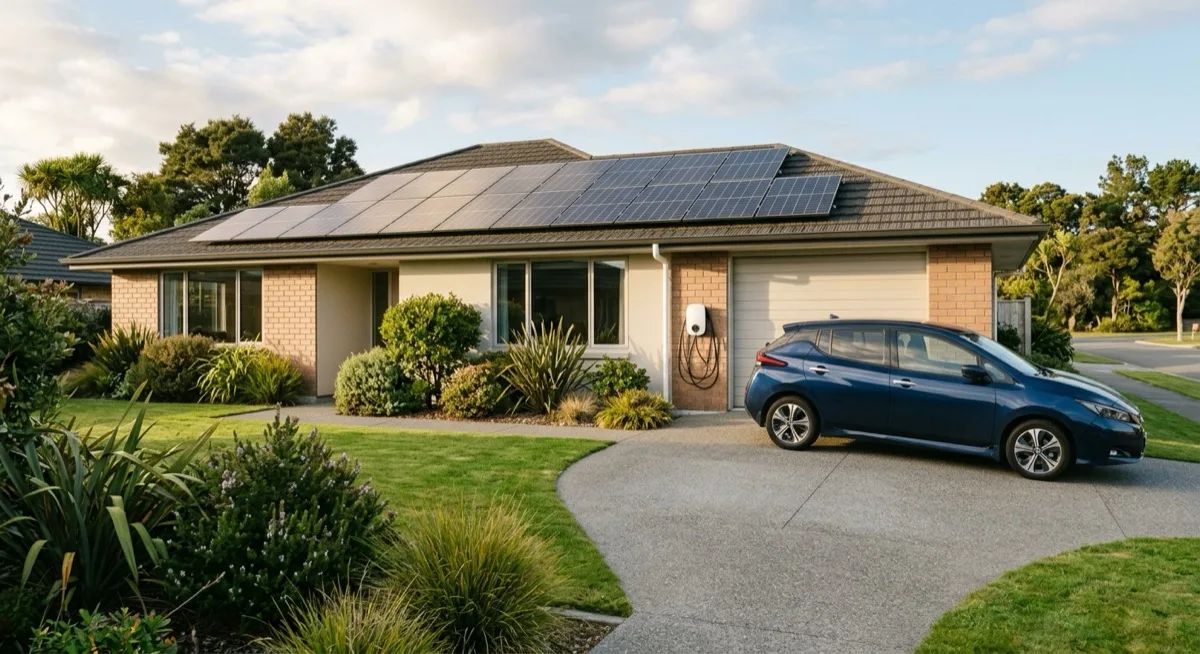
The shift from export to self-consumption
For years the simple advice was “put solar on the roof and export what you don’t use.” That maths has changed. As more homes have added solar, retailer buy-back (export) rates have generally softened, while the import rate you pay has not. When there’s a big gap between the two, every kilowatt-hour of solar you use yourself is worth more than one you export.
That’s exactly why EV charging and solar are such a good pairing. An EV is a large, flexible load you can point at your surplus. Instead of exporting cheap and buying back expensive, you store the sun in the car’s battery. Check your own retailer’s import and export rates side by side; the wider the gap, the more self-consumption (and solar EV charging) is worth to you. Rates and rules shift, so treat any published figure as indicative and confirm the current position with your retailer or the Electricity Authority.
Charging the car from your panels
The practical tool here is solar diversion (also called solar matching or eco mode), a feature on many smart chargers. The charger watches your surplus export in real time and ramps the car’s charging up and down to match it, so the car sips free solar rather than pulling from the grid. Our EV charging with solar guide covers how the diversion modes work in detail.
The catch is timing: solar diversion only helps when the car is home and the sun is out. If your EV is at work all day, most of your charging still happens overnight, which is why an off-peak or EV power plan remains the backbone of cheap charging for most households, with solar diversion as a weekend and work-from-home bonus.
Where a home battery fits
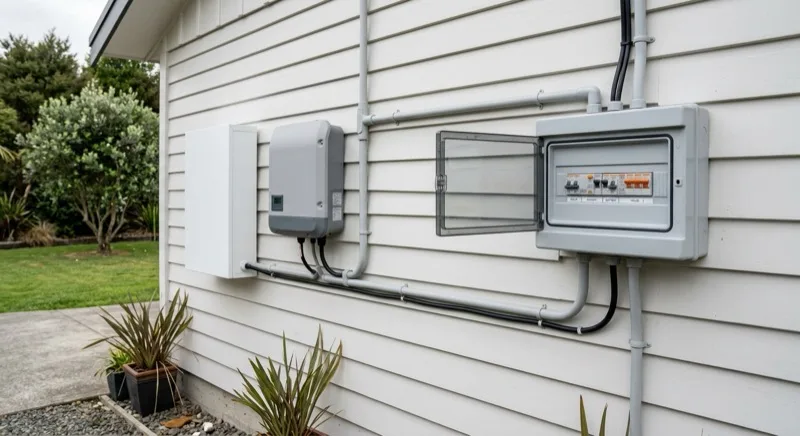
This is where people most often over-invest. A home battery stores your daytime solar surplus to use in the evening: genuinely useful for running the house after dark and for resilience during outages.
 But as a way to charge an EV, a battery rarely stacks up on
its own:
But as a way to charge an EV, a battery rarely stacks up on
its own:
- Filling an EV takes far more energy than a typical home battery holds, so the battery can only ever contribute a slice of a charge.
- An off-peak power plan already gives you cheap overnight charging with no extra hardware, so the battery isn’t buying you much on the car specifically.
- The best case is a battery bought for whole-home reasons (evening shifting, backup, maximising self-consumption) where cheaper EV top-ups are one benefit among several, not the justification.
If you’re getting solar quotes, ask the installer to model your household with and without a battery, and look at the payback honestly. Use our running-cost calculator to sanity-check how much you’d actually save on the car.
V2H: your EV as the battery
There’s a twist that could change this equation: vehicle-to-home (V2H), where a compatible EV and charger feed the car’s own (large) battery back into your house. In principle that removes the need for a separate home battery: the car is the battery. It’s still uncommon in New Zealand and depends on specific vehicle and hardware support, but it’s the technology to watch. The more widely available cousin, vehicle-to-load (V2L), lets the car run appliances or tools from a socket today. Our vehicle-to-grid and V2H guide covers where it’s all at.
Setting it up
To get the most from solar and an EV:
- Choose a charger with solar diversion and dynamic load management. Tell your installer this matters, as not every unit supports it. See the smart charger guide.
- Get the export/import gap clear with your retailer so you know what self-consumption is worth to you.
- Keep an off-peak plan as your default for overnight charging, and treat solar as the daytime bonus.
- Decide on a battery for the whole home, not just the car, and model the payback.
A home charger is fixed electrical work, so a Registered Electrician installs it and issues a Certificate of Compliance; solar and battery work is a separate specialist job. If you’d like installers to quote your actual setup, tell us you have (or are planning) solar in the quote form and we’ll match you with someone who fits solar-aware chargers.
Frequently asked questions
Can I charge my EV directly from my solar panels?
Yes, if you have a smart charger with solar diversion (sometimes called solar matching or eco mode). It watches how much surplus your panels are sending to the grid and ramps the car's charging up and down to soak up that surplus, so you charge on free solar rather than paying to import. It works best on sunny days when the car is home, for many people that's weekends, or a work-from-home midweek. Your installer can confirm your charger supports it.
Is a home battery worth it just for EV charging?
Usually not on its own. A battery large enough to fill an EV overnight would be very expensive, and an off-peak power plan already gives you cheap overnight charging without the hardware. A battery makes more sense for whole-home resilience and shifting your general solar surplus into the evening, with EV charging as one of several benefits, not the main reason to buy one. Run your own numbers before committing.
Should I use my solar to charge the car or export it to the grid?
It depends on the gap between what you pay to import power and what your retailer pays you to export it. When the buy-back (export) rate is well below the import rate (which is common), every kWh of solar you use yourself to charge the car is worth more than exporting it. That's why solar diversion and self-consumption have become more attractive as export rates have softened. Check your own retailer's import and export rates to compare.
What is V2H and can my EV power my house?
Vehicle-to-home (V2H) lets a compatible EV and charger feed stored battery energy back into your house, effectively using the car as a large home battery. It's still uncommon in NZ and needs specific vehicle and hardware support. Vehicle-to-load (V2L), where the car runs appliances from a socket, is more widely available. See our vehicle-to-grid and V2H guide for where the technology is at.
Do I need a special charger for solar EV charging?
You need a smart charger that supports solar diversion and, ideally, dynamic load management. Not every charger does, so tell your installer up front that solar matching matters to you and they'll recommend a suitable unit. A basic charger will still work. It just won't automatically prioritise your solar surplus.