Charger guide
PHEV home charging in NZ: do you need a wall charger or will portable do?
Plug-in hybrid batteries are small and charge rates are low. Whether a dedicated wall charger is worth it for your PHEV, or a portable EVSE is enough.
Plug-in hybrid owners face a different question than pure EV owners when it comes to home charging. With a smaller battery and a lower maximum AC charge rate built into the car, the case for a dedicated wall charger is less clear-cut. Here’s an honest answer for NZ PHEV drivers.
The short answer
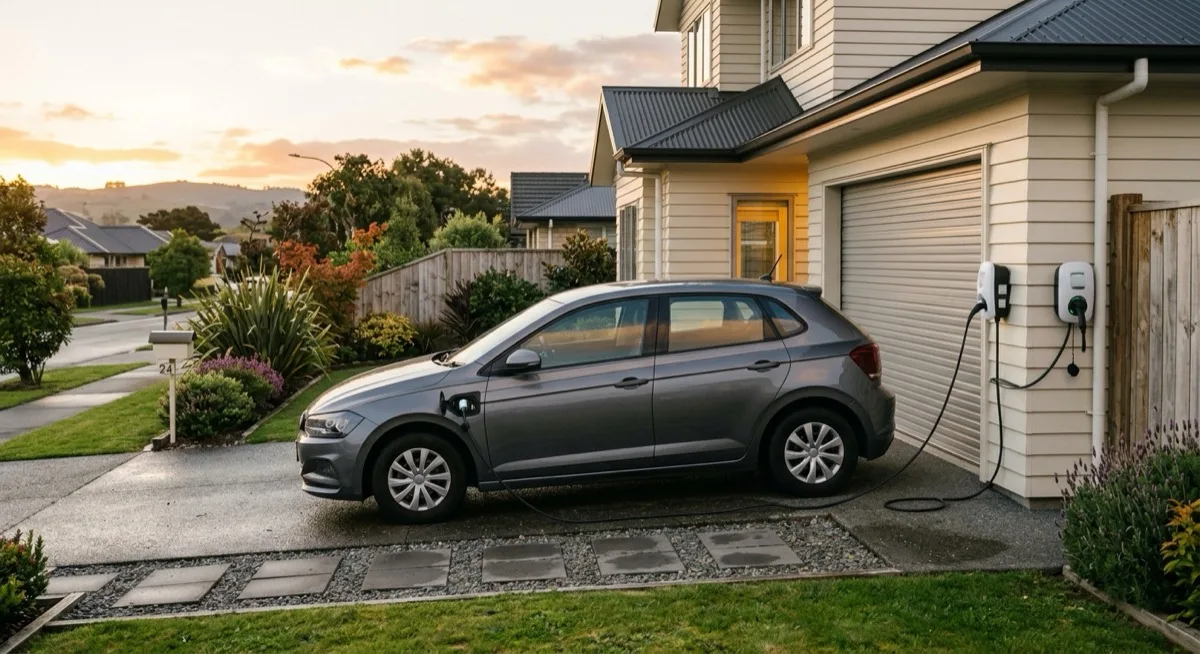
For many PHEV owners, a good portable EVSE is genuinely enough, particularly for overnight top-ups on a small battery. A dedicated 7kW wall charger still makes sense if you want a permanent tidy install, smart-charging controls, or plan to eventually move to a full BEV. But unlike a BEV owner, you won’t be leaving speed on the table if you skip the wallbox.
How PHEV charging differs from BEV charging
A battery electric vehicle (BEV) typically has a large battery, often 50kWh or more, and an onboard AC charger that accepts 7kW or higher. That combination means a dedicated wall charger meaningfully shortens charging time and is almost always worthwhile.
A plug-in hybrid electric vehicle (PHEV) works differently on both counts:
- Smaller battery. PHEV batteries are typically in the rough range of 10–20kWh, a fraction of what a BEV carries. That means even a slow charge rate fills the battery in a matter of hours.
- Lower onboard AC charge rate. Many PHEVs sold in NZ accept only around 3.6–3.7kW AC on single-phase supply. This is a limit set by the car’s own onboard charger hardware, and it has nothing to do with your home’s wiring or the charger you buy. Some newer PHEVs accept 6.6kW or 7.4kW, but many in the NZ market sit at the lower figure.
These two facts change the maths significantly.
Do you need a wall charger, or is a portable EVSE enough?
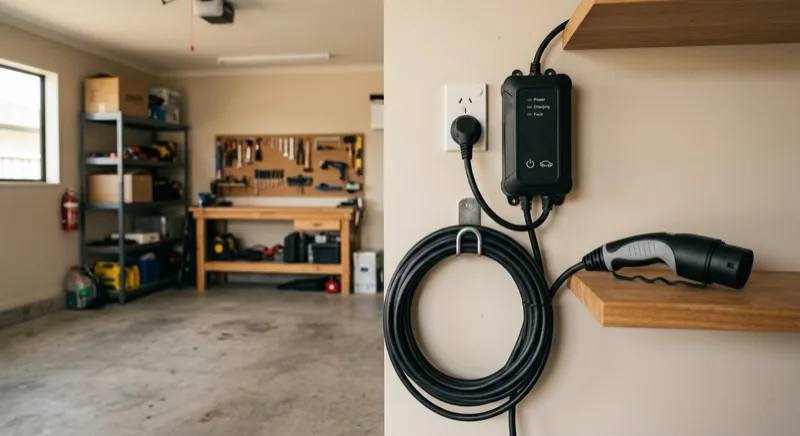
A portable EVSE (sometimes called a Mode 2 or Mode 3 portable charger) plugs into an existing outlet and connects to your car’s Type 2 connector. Depending on the outlet it’s plugged into, delivery is roughly:
| Outlet type | Approx. charging rate | Time to fill a 15kWh battery |
|---|---|---|
| Standard 10A 3-pin | ~2.3kW | ~6–7 hours |
| Dedicated 16A outlet | ~3.6–3.7kW | ~4–4.5 hours |
| Dedicated 32A circuit (7kW wallbox) | Up to car’s limit (e.g. 3.7kW) | ~4–4.5 hours |
If your PHEV caps out at 3.6–3.7kW, the last two rows are identical in charge time. A 7kW wallbox charges your PHEV at exactly the same speed as a 16A portable EVSE would, because the car is the bottleneck, not the charger.
For overnight use, even a 3-pin outlet is often enough: plug in before bed, wake up to a full battery. The portable vs wall-mounted charger guide covers the broader trade-offs between these two approaches.
Speed reality for small PHEV batteries
Here’s the practical picture. A 15kWh PHEV battery, a broadly representative size, charged from flat at 3.6kW takes roughly four to four-and-a-half hours. Most PHEV owners don’t charge from flat each night; they return home with 20–40% remaining and top up. A realistic top-up session is often just two to three hours.
That means:
- Plugging in when you arrive home in the evening and unplugging in the morning covers nearly any scenario, even on a modest outlet.
- You don’t need a rapid turnaround during the day the way a BEV driver with a large battery might.
- The speed advantage of a 7kW wall charger over a good portable EVSE is essentially zero if your car’s AC limit is below 7kW.
The off-peak tariff argument applies to both approaches equally: scheduled charging overnight takes advantage of lower electricity rates regardless of whether you use a wallbox or a portable unit.
When a dedicated 7kW wall charger still makes sense for a PHEV
There are genuine reasons to install a wallbox even if the speed benefit is marginal:
1. Your PHEV accepts more than 3.7kW AC. Some newer plug-in hybrids accept 6.6kW, 7.2kW, or 7.4kW. If yours does, a 7kW wallbox will charge noticeably faster than a 16A portable EVSE. Check your car’s specifications: look for “onboard charger capacity (AC)” in the technical data.
2. You’re planning to get a BEV in future. Installing a dedicated circuit and wall charger now means the infrastructure is ready when you upgrade. Retrofitting later costs the same in electrical work but means a second installation visit.
3. You want smart-charging features. Many wallboxes offer scheduled charging, solar integration, and load management that portable EVSEs don’t. If you have solar panels or a managed tariff, these features can reduce running costs.
4. Permanent tidiness and safety for a garage installation. A wall-mounted unit with a tethered or socketed Type 2 connector is neater and more durable than a portable cable coiled on a shelf. It also keeps a heavy-gauge cable off the floor.
5. You share a household with a BEV. One dedicated circuit serves both vehicles at full speed for the BEV and is more than adequate for the PHEV.
What does installation cost for a PHEV charger?
The installed cost of a 7kW wall charger for a PHEV is the same as for a BEV. The hardware and labour don’t change because your car has a smaller battery. A typical 7kW wall-mounted install runs indicatively around $1,500–$2,500 all-in, covering the wall unit, a dedicated circuit from your switchboard, installation labour by a Registered Electrician, and a Certificate of Compliance. The actual figure depends on your switchboard’s spare capacity, cable distance to the parking area, and whether any switchboard work is needed.
A dedicated 16A outlet, a lower-cost alternative that achieves the same charge rate as many PHEVs can accept, may be cheaper to install than a full wallbox, depending on the run and hardware chosen. See the full installation cost guide for a detailed breakdown of each cost variable.
By contrast, a portable EVSE requires no installation cost if you already have a suitable outlet nearby. If you need a dedicated outlet added, that work still requires a Registered Electrician and a CoC, but is typically less expensive than a full wallbox install.
Our recommendation for PHEV owners
-
Confirm your car’s maximum AC charge rate first. This is the single most important number. If it’s 3.6–3.7kW, a good portable EVSE on a 16A dedicated outlet is functionally equivalent to a wall charger for daily charging.
-
If a portable EVSE is enough for your current situation, start there. You can always upgrade the permanent install when circumstances change: a second vehicle, a house move, or switching to a full BEV.
-
Install a wall charger if you want the infrastructure futureproofed, or if your car can genuinely use more than 3.7kW AC. The cost is the same regardless of which car is plugged in, and the work only needs to be done once.
-
Get a Registered Electrician to assess your switchboard before committing to any dedicated circuit. Older switchboards may need an upgrade that affects the overall cost picture. A proper quote request ties the assessment and installation into one job.
What to send for an accurate quote
Whether you’re getting a full wallbox install or a dedicated outlet for a portable EVSE, these details help an installer give you a reliable price upfront:
- A photo of your switchboard (door open if safe). This lets the installer assess spare capacity and flag any likely upgrade early.
- A photo of your parking location: garage, carport, or driveway; covered or exposed; and how far it is from the house.
- Approximate cable route from switchboard to parking: distance, wall materials, and any obstacles (concrete, paving, long runs under the driveway).
- Your PHEV make, model, and year: helps confirm the Type 2 socket standard and your car’s actual AC charge rate limit.
- Whether you have single-phase or three-phase supply: most NZ homes are single-phase, which is all a PHEV charger needs, but it’s worth confirming.
- Any smart-charging or solar preferences: if you have panels or a managed tariff, mention it so the installer can recommend an appropriate unit.
Frequently asked questions
Do I need a wall charger for a PHEV?
Not always. Many PHEVs have small batteries (roughly 10–20kWh) and accept only around 3.6–3.7kW AC. A portable EVSE plugged into a standard 10A or 16A outlet can fully recharge a small PHEV battery overnight in most cases. A dedicated 7kW wall charger still makes sense if you want a tidy permanent installation, smart-charging features, or a faster outlet for convenience, but it won't charge a 3.6kW-limited PHEV any faster than a good portable unit.
Will a 7kW charger charge my PHEV faster?
Only up to your car's own limit. If your PHEV's onboard AC charger accepts a maximum of 3.6kW or 3.7kW, a 7kW wallbox will deliver exactly that rate and no more. The car's onboard charger is the bottleneck, not the wallbox. You won't damage anything; you simply won't see the speed benefit a full BEV owner would.
How long does it take to charge a PHEV at home?
It depends on battery size and charging rate. A 15kWh battery charged at 3.6kW takes roughly four to four-and-a-half hours from empty. Most PHEV owners top up partially rather than charging from flat, so real-world sessions are often shorter. Overnight charging, even on a 3-pin outlet, covers nearly any PHEV battery if you plug in before bed.
Can I use a 3-pin socket to charge a PHEV?
Yes, for many PHEVs a standard 3-pin outlet (via a Mode 2 portable EVSE supplied with the car or bought separately) delivers around 2.3kW and is often enough for overnight top-ups given the small battery. It is not ideal as a permanent solution (it draws continuous load on a general-purpose circuit not designed for that), but as an occasional backup it works.
What's the difference between charging a PHEV and a BEV at home?
Mainly battery size and maximum AC charge rate. BEVs typically have large batteries (50–100kWh or more) and accept 7kW or higher AC, so a wall charger makes a big practical difference. PHEVs have much smaller batteries and many cap AC charging at 3.6–3.7kW, so the gap between a portable EVSE and a wall charger is smaller. The decision calculus is different: for a PHEV, convenience and installation neatness often matter more than raw speed.
Do PHEV chargers need a Certificate of Compliance in NZ?
Any permanent fixed wiring, such as a dedicated circuit for a wall charger, must be done by a Registered Electrician and signed off with a Certificate of Compliance under New Zealand's electrical safety rules. A portable EVSE plugged into an existing outlet doesn't require new electrical work, but if you add a dedicated outlet or circuit for it, that work needs a CoC too.